

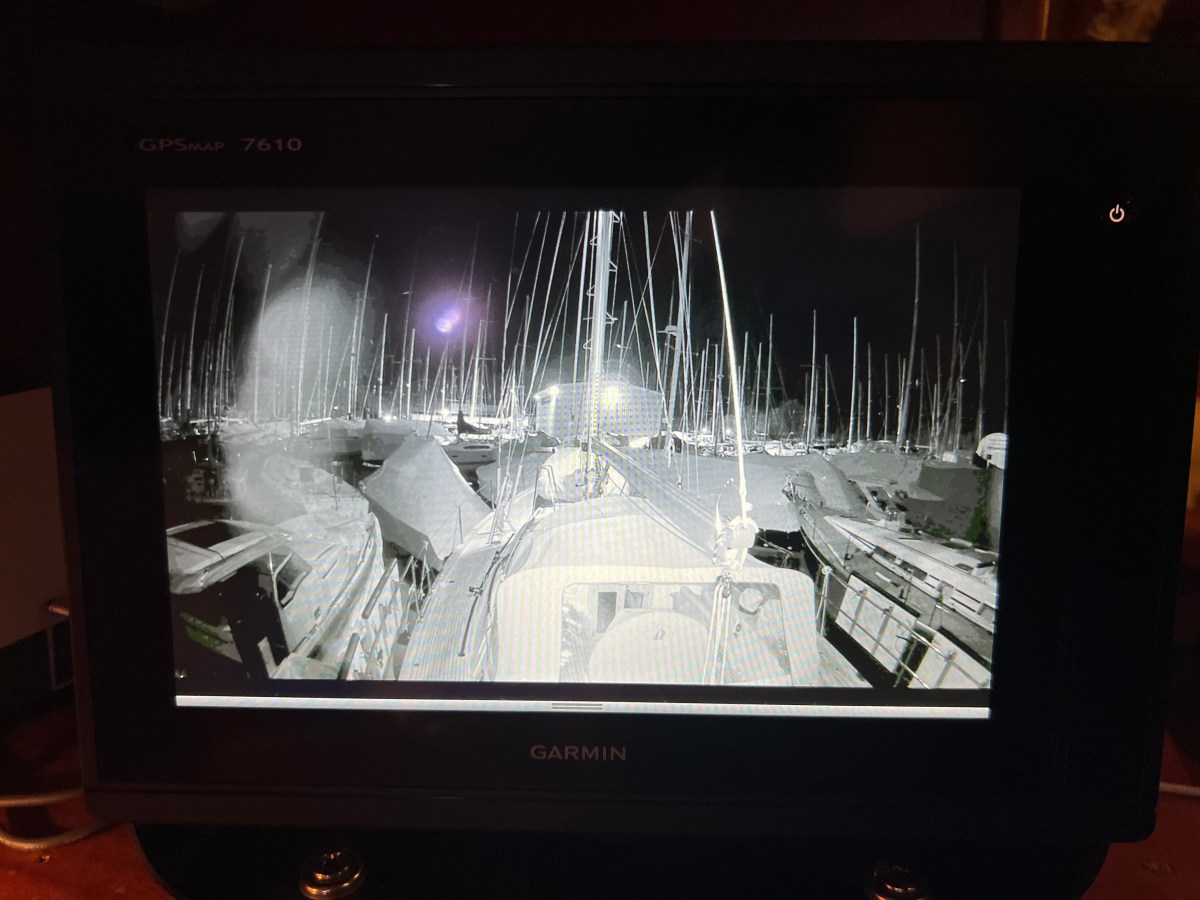
This Winter on land at Bert Jabins Yacht Yard, we upgraded several of our data and visualization systems aboard Skyward. The systems that came with the boat were from 2016 or earlier and some didn’t work any longer. While walking the Annapolis Boat Show in 2024, I accidentally picked up some new electronics from the GPS Store.
Basis of Design: Why Did We Do What We Did?
- Which brand for data visualization? We have experience with Garmin, Raymarine and B&G systems on other boats or charters. We already own a Garmin chartplotter aboard Skyward. In my research, Garmin is a corporation that has made several technology acquisitions and is obviously engaged in a lot of sports beyond sailing. Garmin acquired our original forward looking sonar manufacturer, Interphase. Based on this, I felt like Garmin was my favorite chartplotter for all around use, visualization, user navigation, and integrability with on-boat and off-boat systems.
- Our autopilot system is based on Raymarine instruments. The scope of this work did not involve any changes to that system to keep the costs down and especially since we have had no major issues there. In other words, the autopilot controller, control head, instruments and displays would all remain Raymarine.
- We wanted as much integration as possible. Raymarine and Garmin devices integrate and share data using NMEA2000. We accepted the fact that the chartplotter or any other Garmin devices could not control our autopilot.
- We wanted a larger and brighter chartplotter in the cockpit to make it easier to see from the helm.
- We also wanted to have access to more data down below at the nav station as well as at the helm.
- With our dinghy stowed on deck, it is difficult to see around it while motoring and navigating marinas and tight/busy channels. We wanted a way to augment our ability to see forward of the bow while underway in these conditions.
The Design: Begin with Proof of Concept
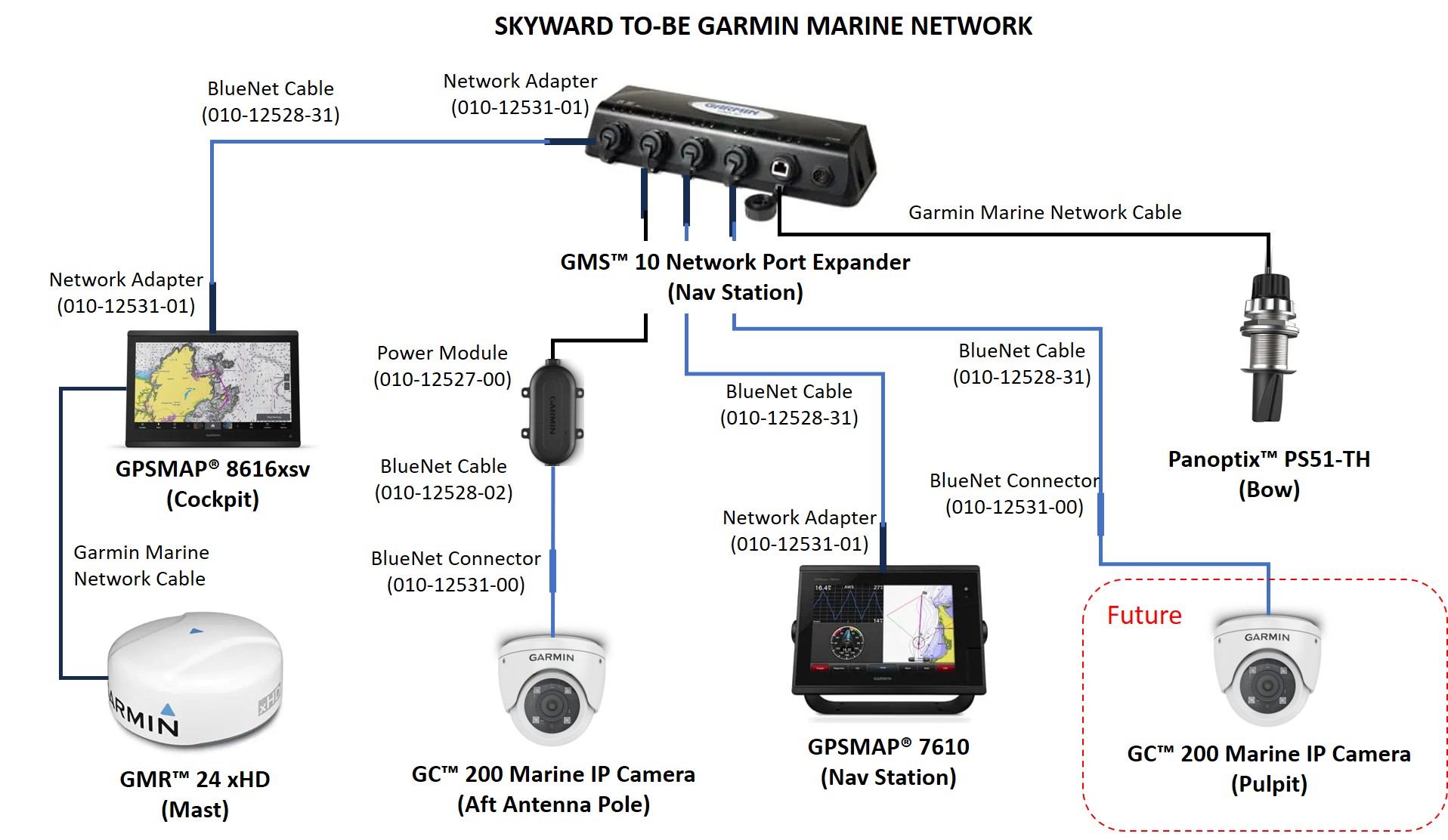
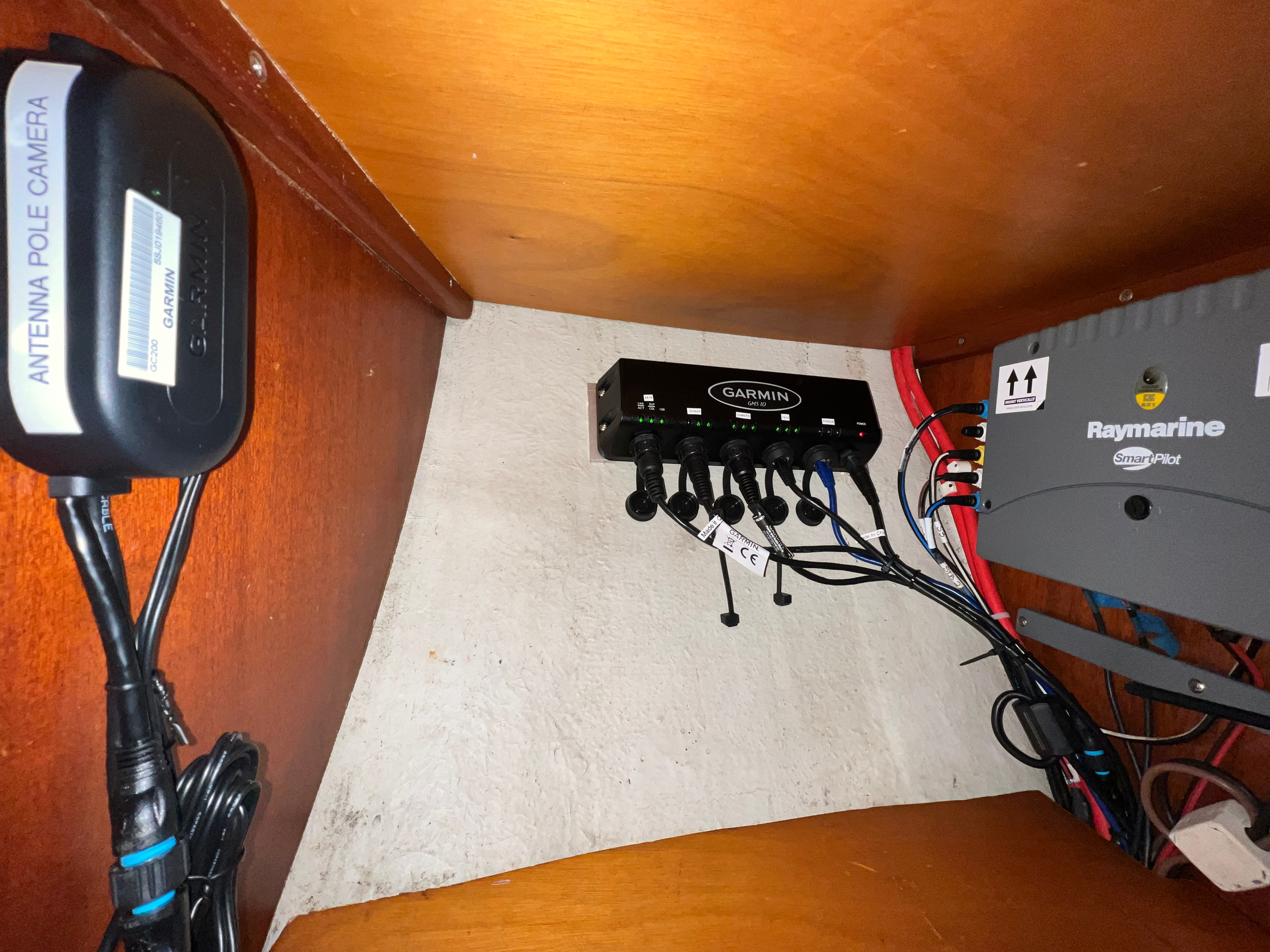
What started everything was doing research online and discovering the Garmin GMS10 Network Port Expander. Googling it, I found a few installations although I didn’t find many videos or online resources for this device. I sketched up a design that I thought would work, and then I went shopping at the Boat Show. The GPS Store shipped me the products quickly, and then I was left with hardware that I still didn’t exactly know how this would work out. I knew that the GMS10 was going to be the centerpiece of the design.
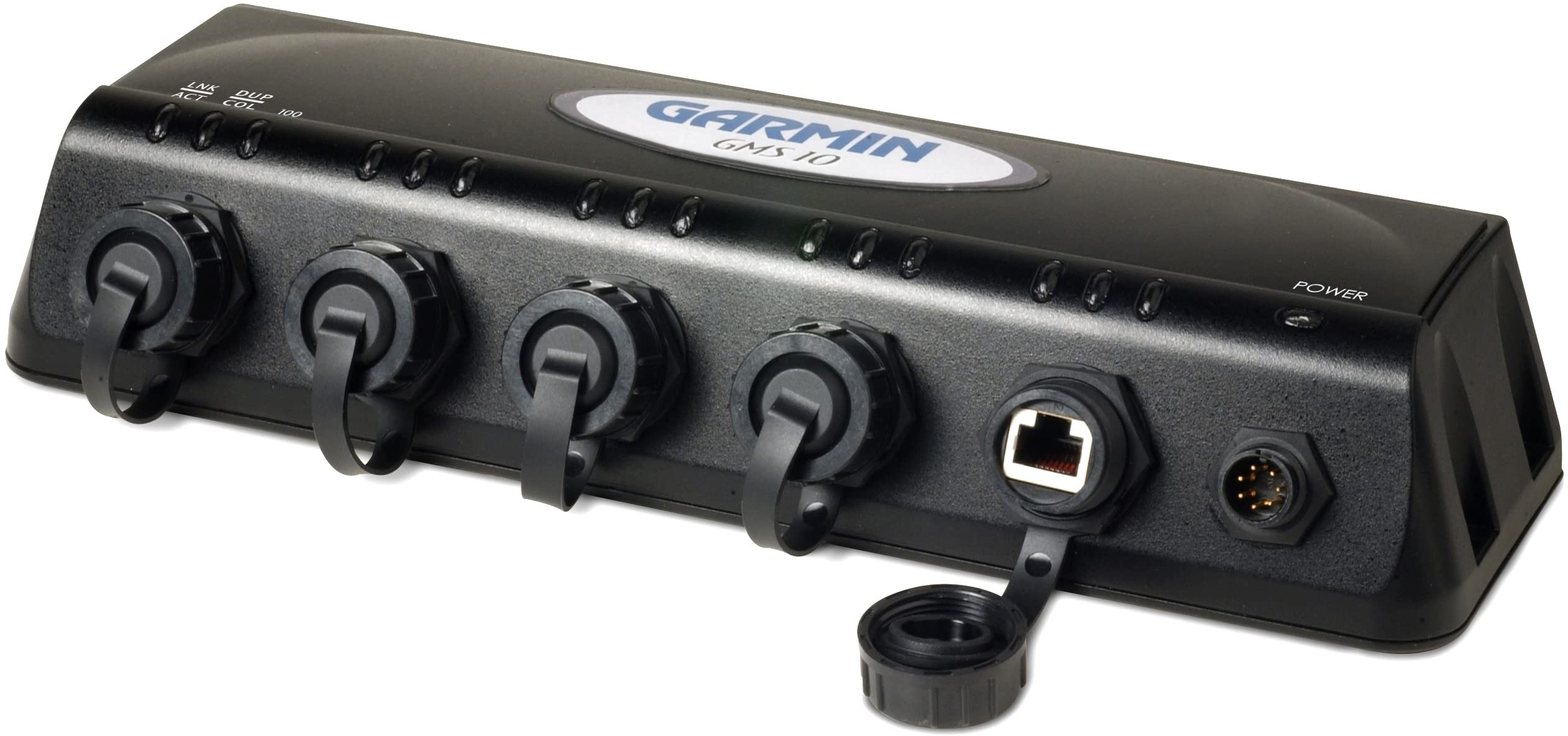
I did some test installations with two chartplotters to simulate the future state which led to a lot of frustration. I installed the network port expander and two chartplotters using basic cables from Garmin, but nothing worked. I switched cables. I flipped cables forward and backward. I plugged in one, unplugged it, then I plugged in the other. Each time I tried, I could only get one chartplotter to work. After several hours of this, I was beginning to think I made a mistake and my wife was getting the same feeling. So, I wrote Garmin.

Their support has been fairly helpful throughout this project. But it is a little quirky how you get to it. First, you navigate to the product you own and need help with. Then, you click the “Get Help” menu option which will allow you to enter a support question, which sends a formatted email to Garmin. I found they respond within 1-5 days which then enables back-and-forth dialogue on that work “ticket”. I have always received a response from Garmin, and more than once, we had back-and-forth clarifying emails. I chose to use email but it is not 100% predictable how long you need to wait in between responses. Chat and phone are available, but I don’t have time during the day for these things.
After several iterations and communications, Garmin finally gave me the answer that I needed. If ANYONE out there is trying to use a Garmin GMS10 with more than 1 chartplotter, you will need to know this:
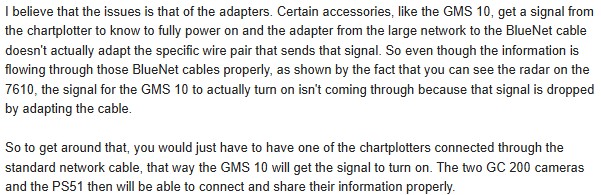
I unplugged one of the chartplotters and found a ethernet cable from a cluttered desk drawer at home, and it worked! That meant that the centerpiece of design was proven to work and give me the results I was looking for: Total integration.
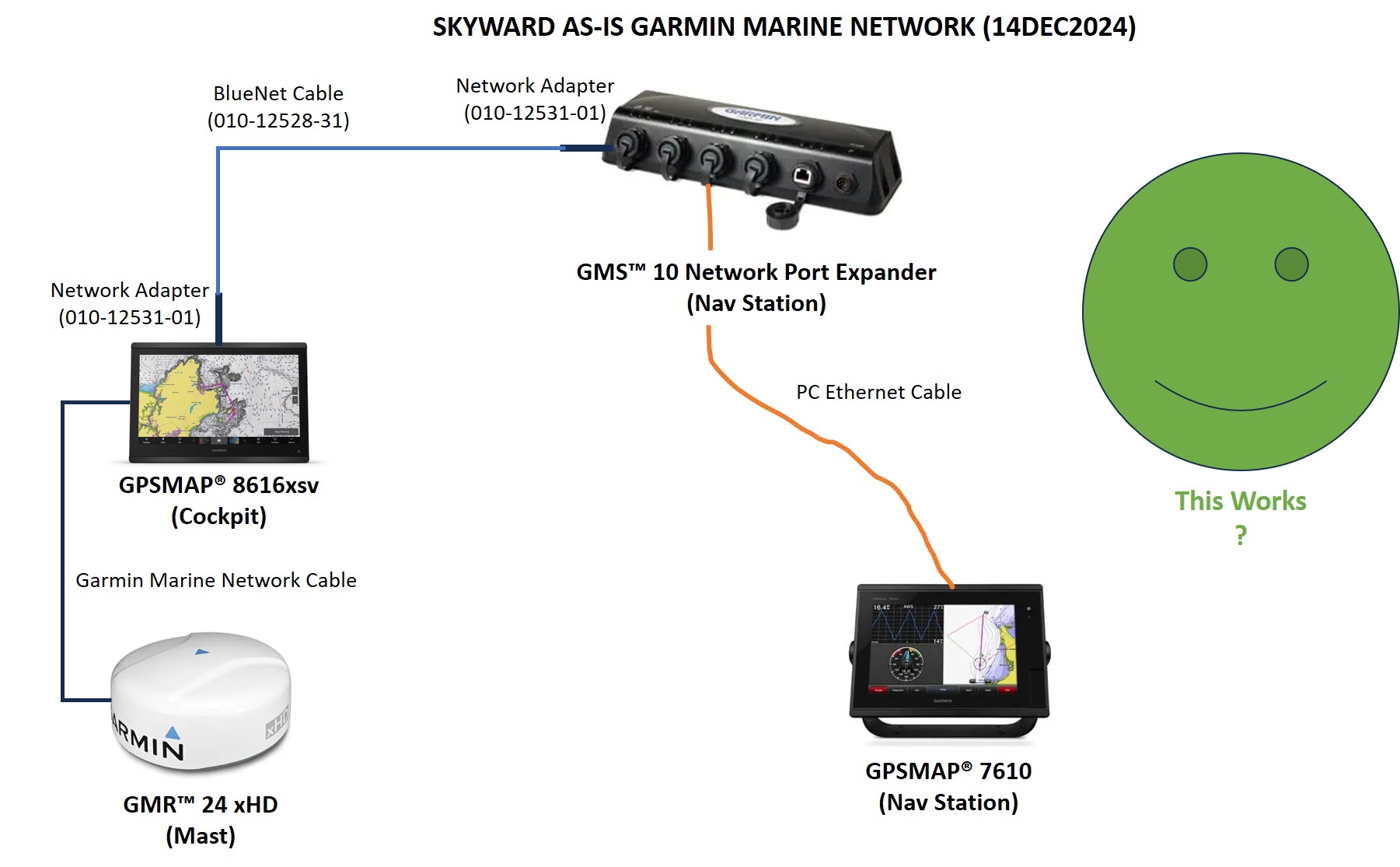
The envisioned Garmin Marine Network would include a couple chartplotters, a couple cameras and a forward looking sonar. One piece of learning that was very helpful late in the project was finding the Garmin product called a “Power Module”. This device (< $100USD) would allow me to send only a Garmin BlueNet cable to the camera instead of both a power line and a cable. That saves on cabling and also reduces the size of holes that I would need to make to install the wiring.
Implementation and Execution
We began the project unaware of the hundreds of feet of abandoned wiring we would be removing from the boat. This project lead me to all corners and dark places in bilges and closets that I never dreamed of. It forced me to really understand the low voltage systems and wiring aboard Skyward. We chased everything from end-to-end including instruments, displays, and lighting. We also discovered some low voltage wiring that had chaffed and which needed to be replaced as well as wiring that was routed lazily or strangly in the past which we corrected. This point cannot be understated; take the time to get rid of abandoned wiring and clean up anything that doesn’t look right.
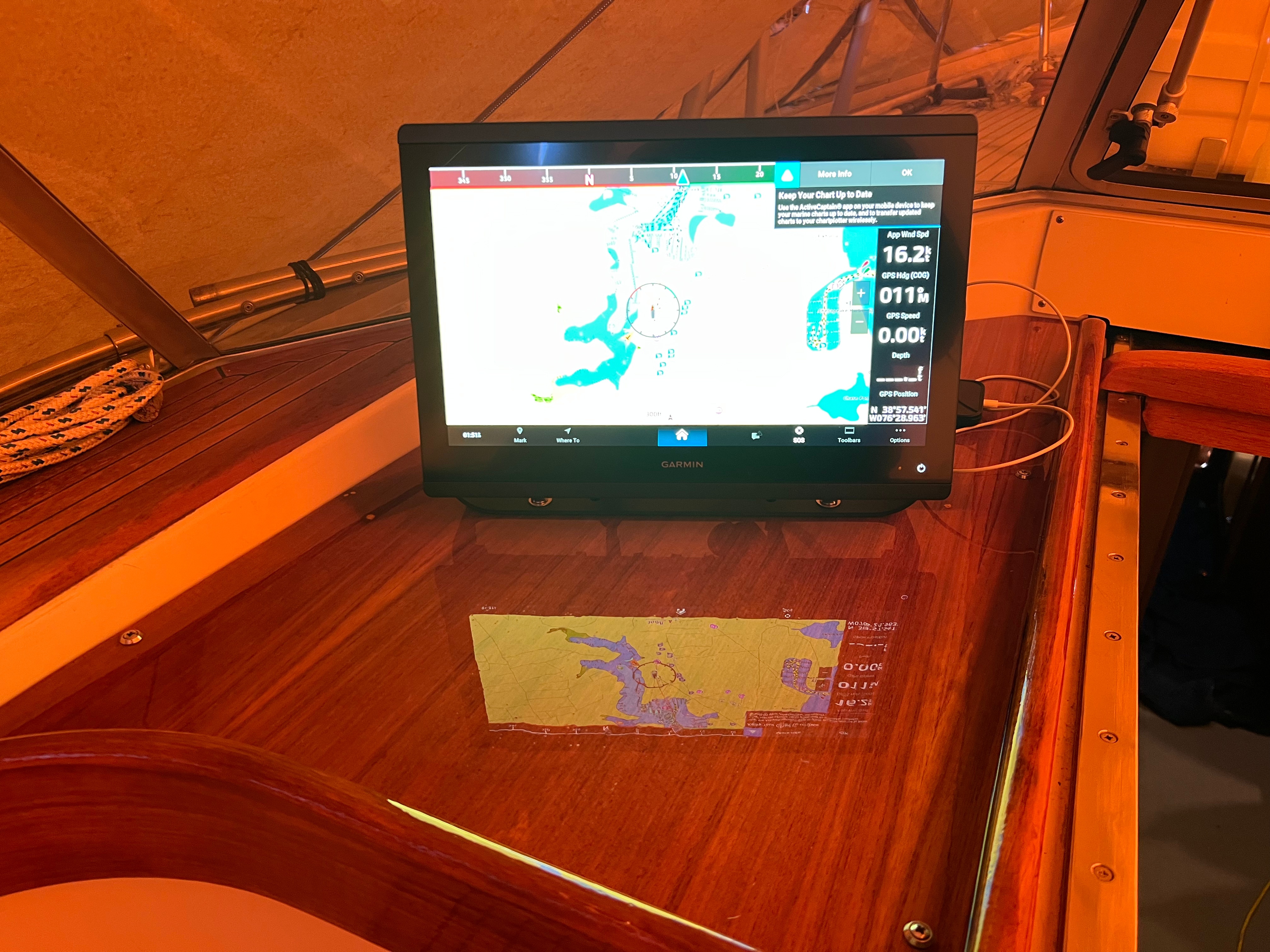
If the Garmin GMS10 was the centerpiece of the design then our new Garmin 8616XSV chartplotter was the start of the show. We installed it in the cockpit on the port table. I removed the original chartplotter and the Interphase display, plugged those holes and then re-varnished the table. The new chartplotter is crisp, fast and is easier to see from the helm position. It’s basically huge.
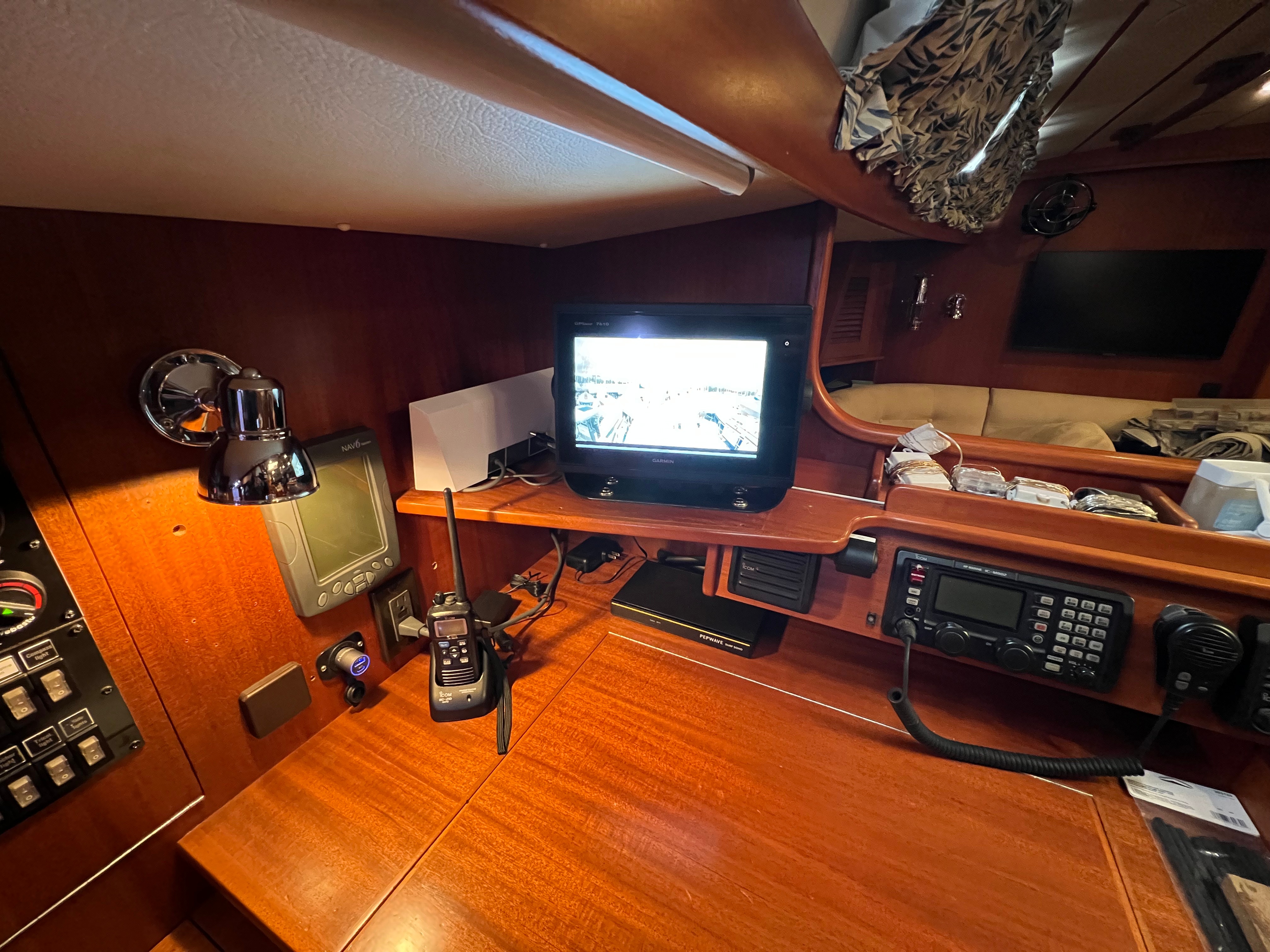
We then mounted the original Garmin 7610 chartplotter above the navigation station. It will be convenient to have so much data and information at this location. This will come in handy when preparing our hourly log on a passage.
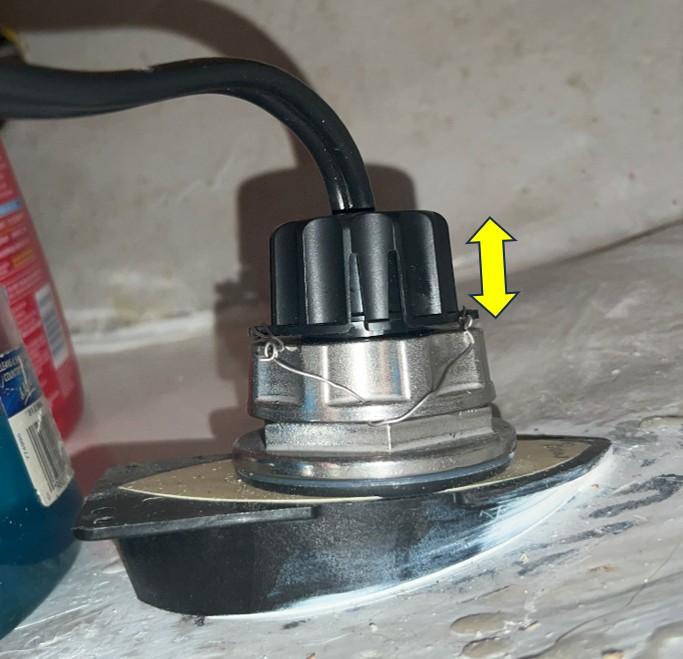
Then we asked Annapolis Boat Service to remove the original forward looking sonar thruhull and install the new thruhull for the new Garmin Panoptix TH-51 sonar sensor. While they were working in this area, we asked them to remove an unused original seacock to supply sea water to the forward head. They did a great job. You might be able to see in the pictures that we will have to do a complete bottom job next year. We did the final installation and wiring of the actual instrument, checked fitment and wire-tied it to the thruhull. I still need to paint the rest of the forward bilge…some day in the future.
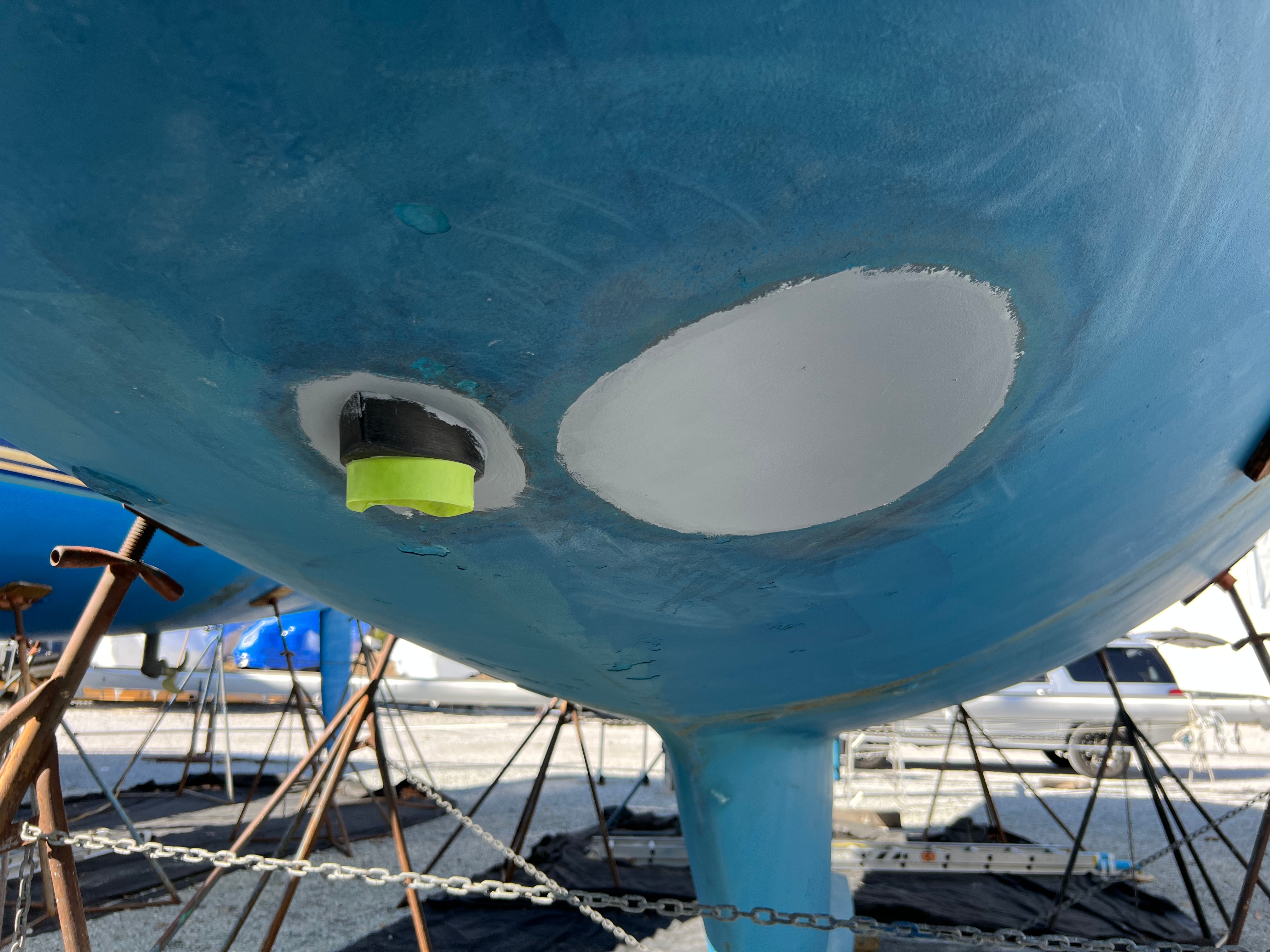
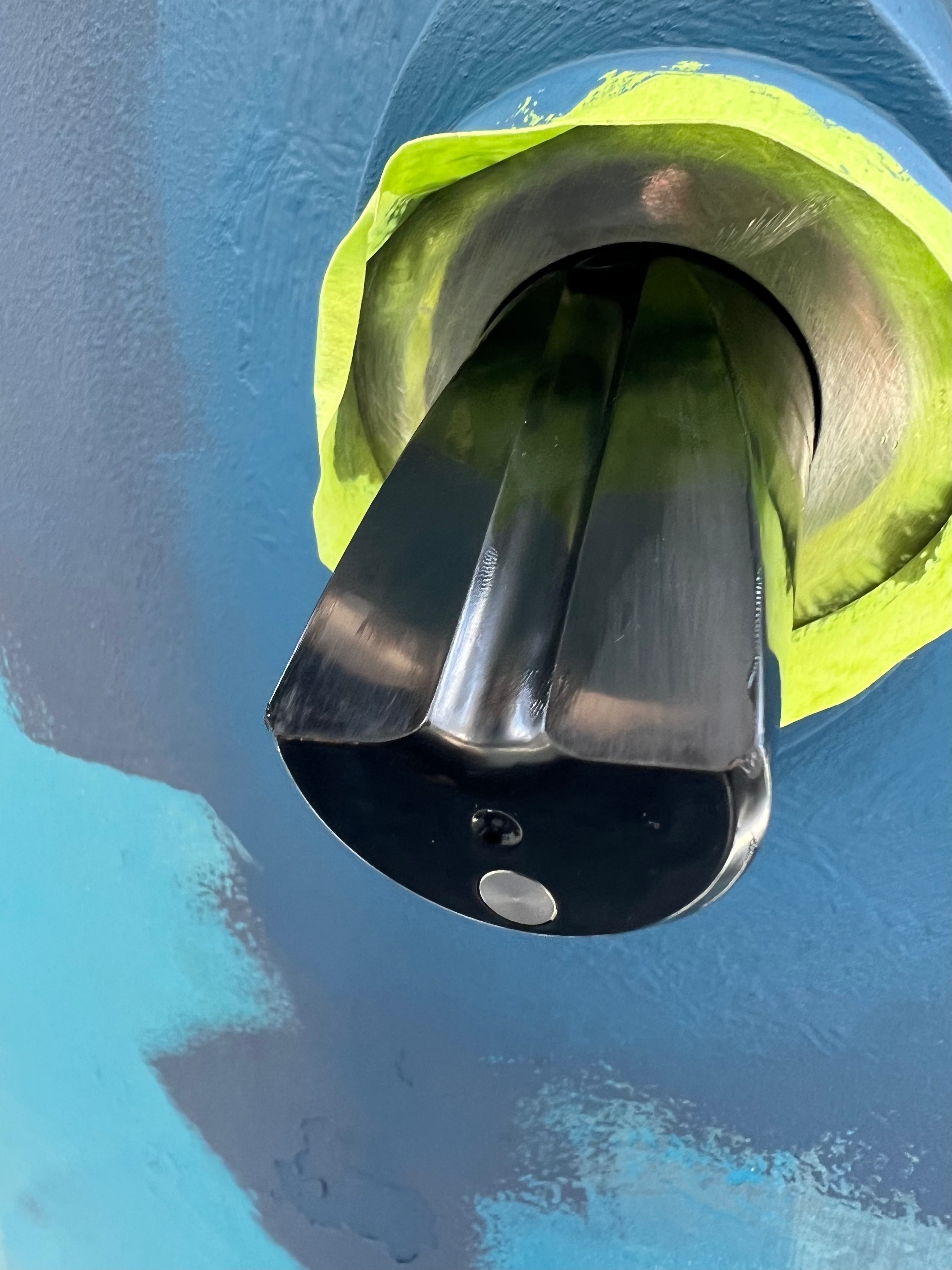
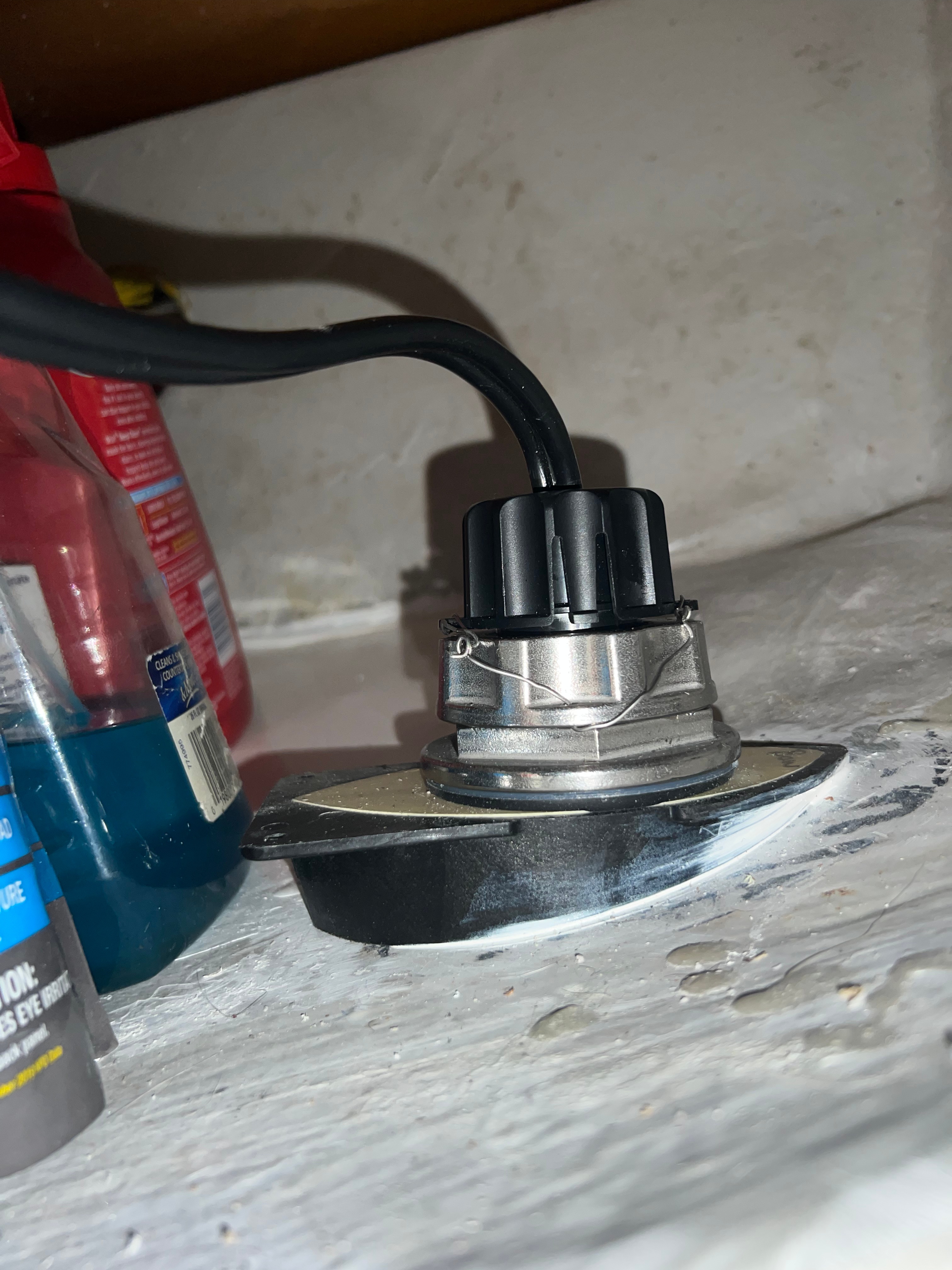
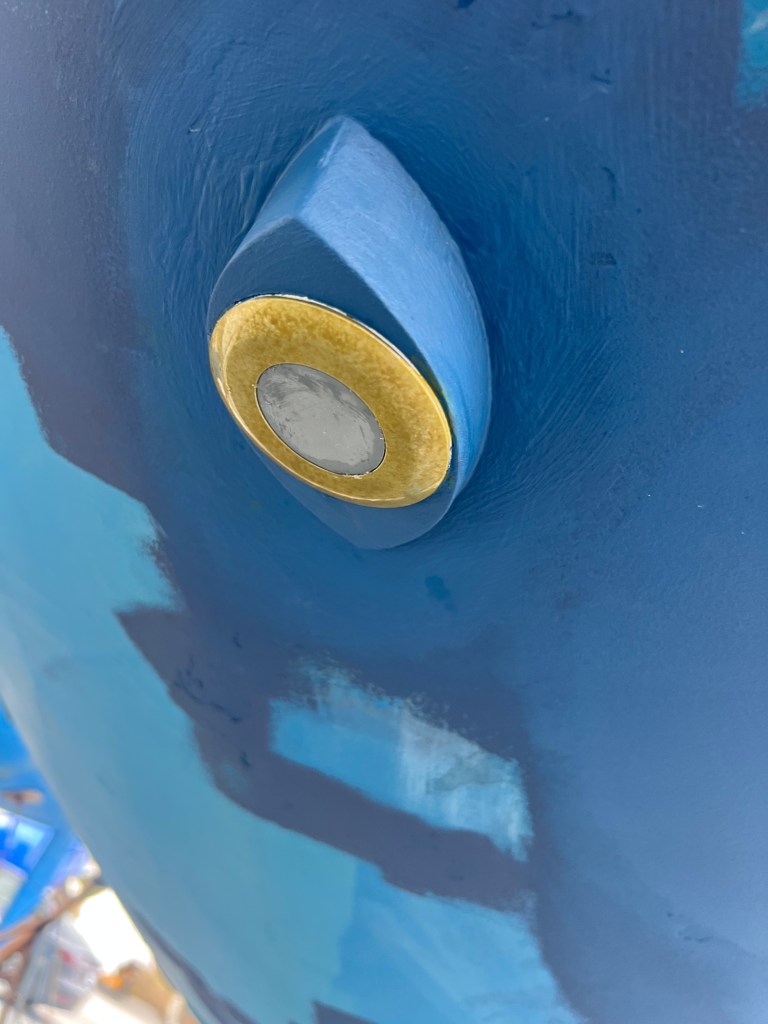

Two points for those considering this sonar device for which Garmin support did not address adequately:
1. The design of the sensor and thruhull allows it to rotate torsionally with very little force. I keep wondering if I didn’t install the sensor correctly. I cranked down on the nut, and it doesn’t not secure it any tighter. There is no keyway or slot to ensure the sensor stays in the forward position at all times. I locked the rotation by adding siezing wire which is recommended in the instructions although the instructions do not tell you why you should apply seizing wire.
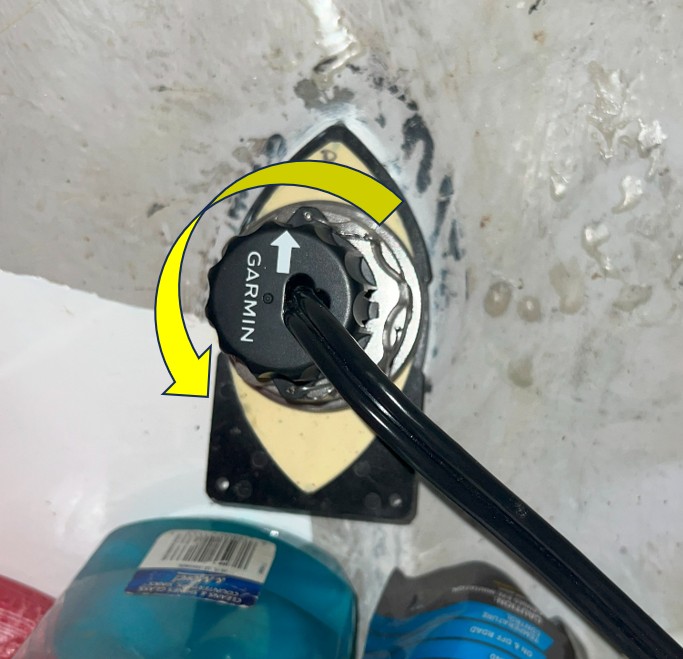
2. The design of the sensor and thruhull allows about 1/8-1/4″ of vertical “play” up and down of either the sensor or the plug that comes with the system. Again, even after cranking down on the nut, the sensor and plug can move up and down by a slight amount. What stops the sensor or plug from coming out of the hole? It must be held in place mechanically by a ridge built into the system. I think this is a miss in the design.
After that major scope was closed out, we spent far too much time contemplating how to install the GC200 camera on the aft antenna pole. I came across the Forespar RailFast Mounting Flange 350 which has the perfect size diameter flange to mate up to the back of the camera. It comes with 4 pre-drilled holes in the flange for mounting attachments; I modified and expanded those holes to meet my needs. The camera installation was actually not to complicated once I figured out the mounting orientation and flange. A lot of this was trial and error.
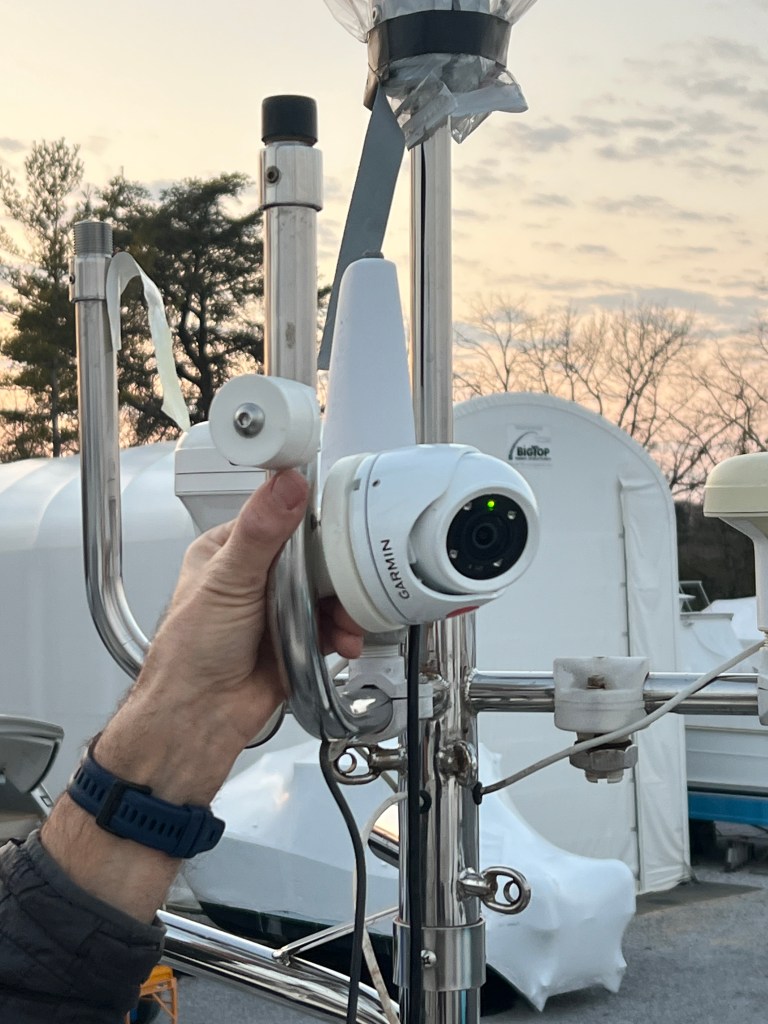
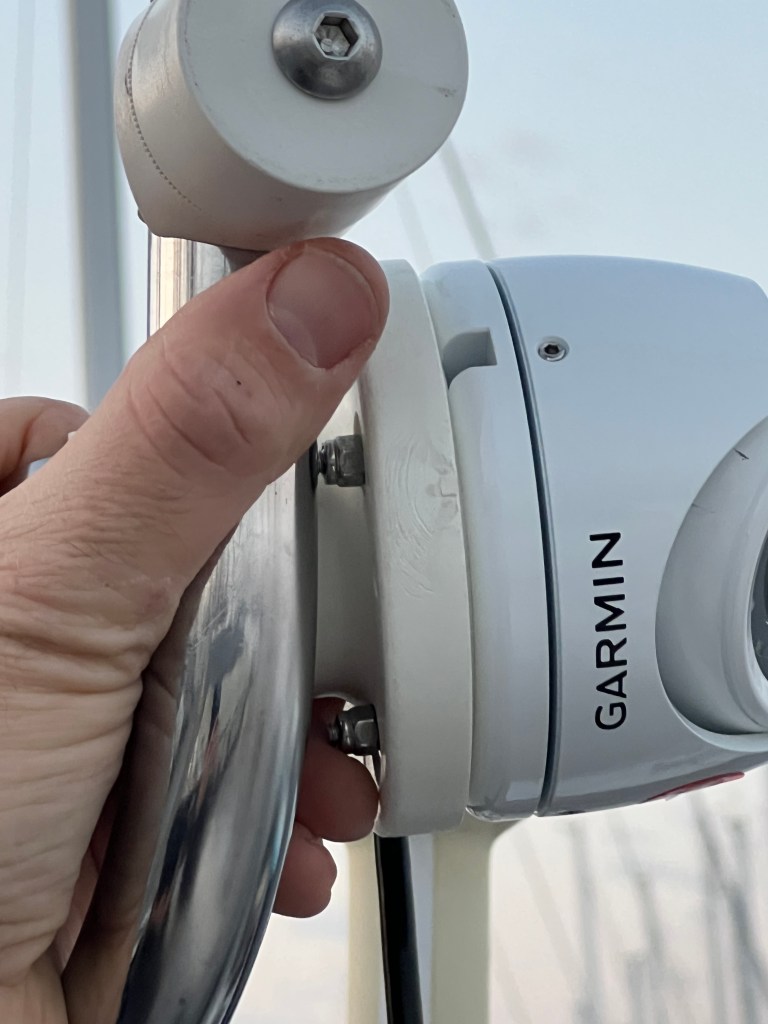
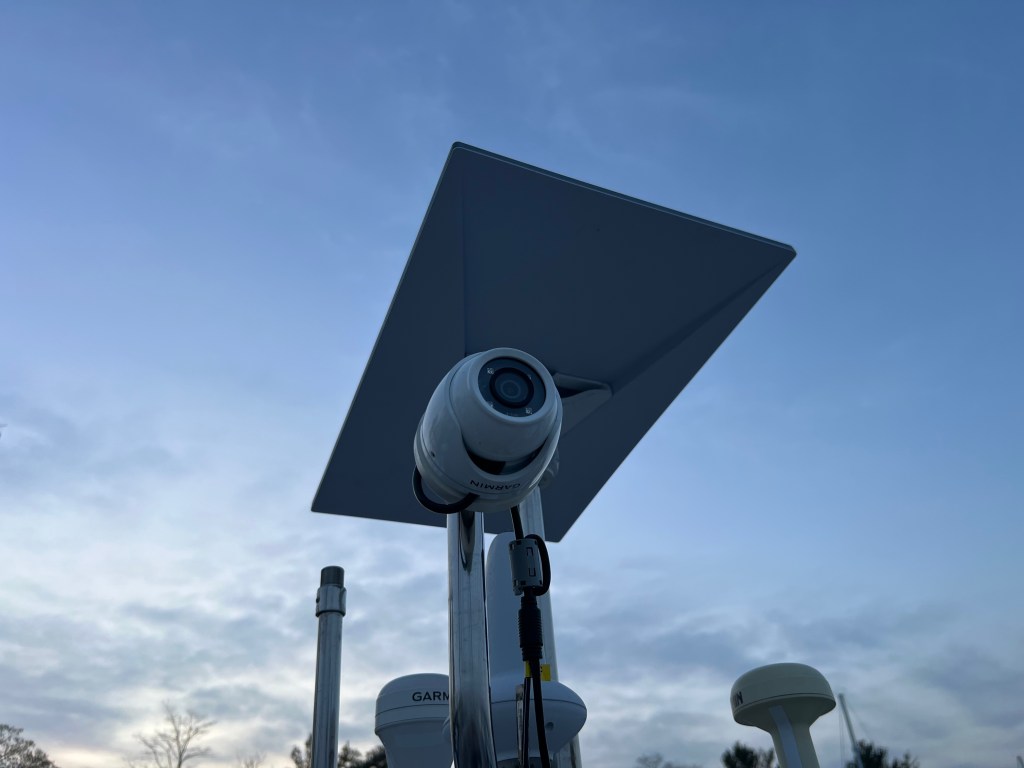
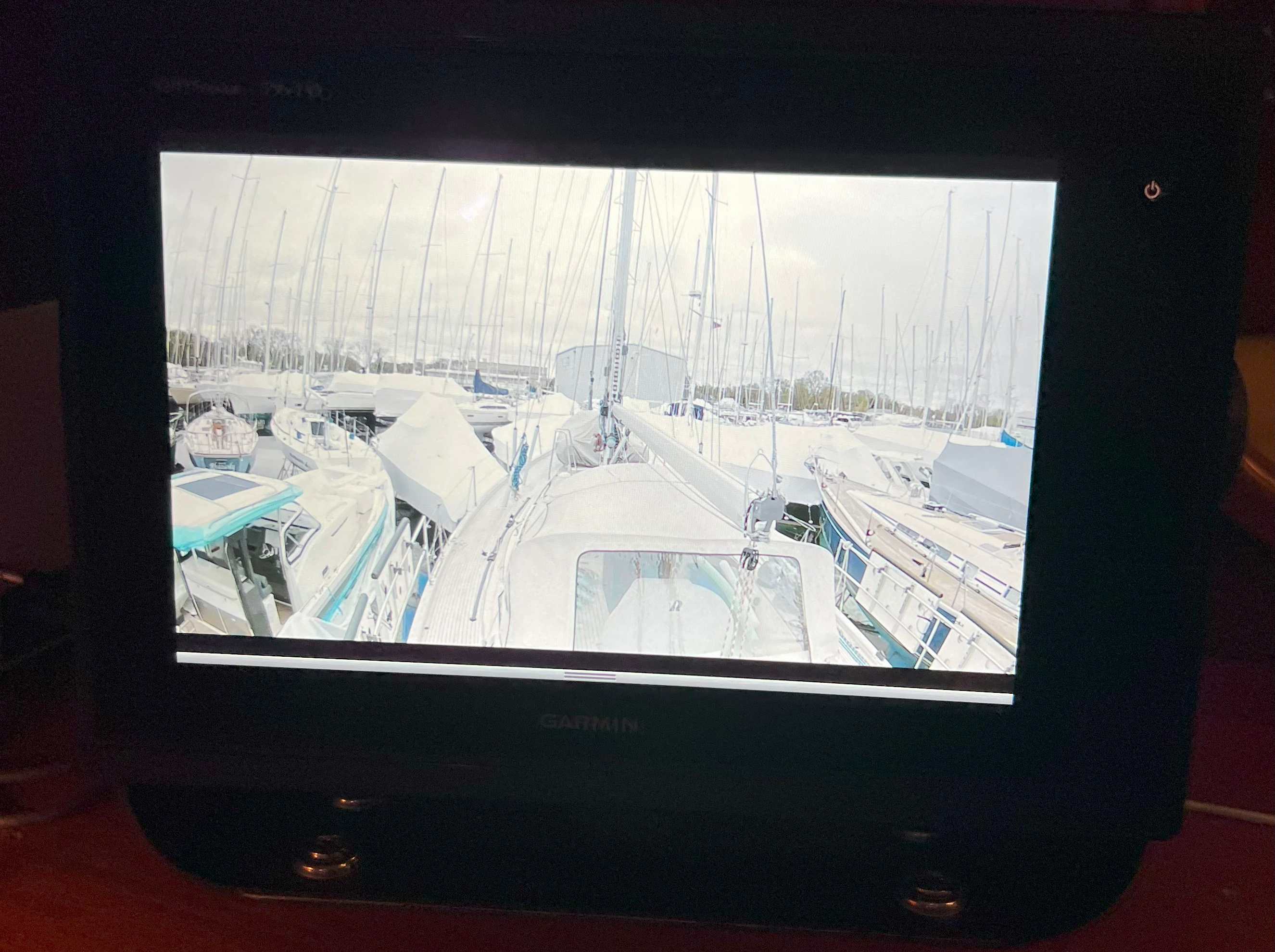
We know there are a lot of other cameras available on the market that are new and more compact, but we chose the GC200 camera for the clarity, distance, angle of view, and also the night vision capabilities.
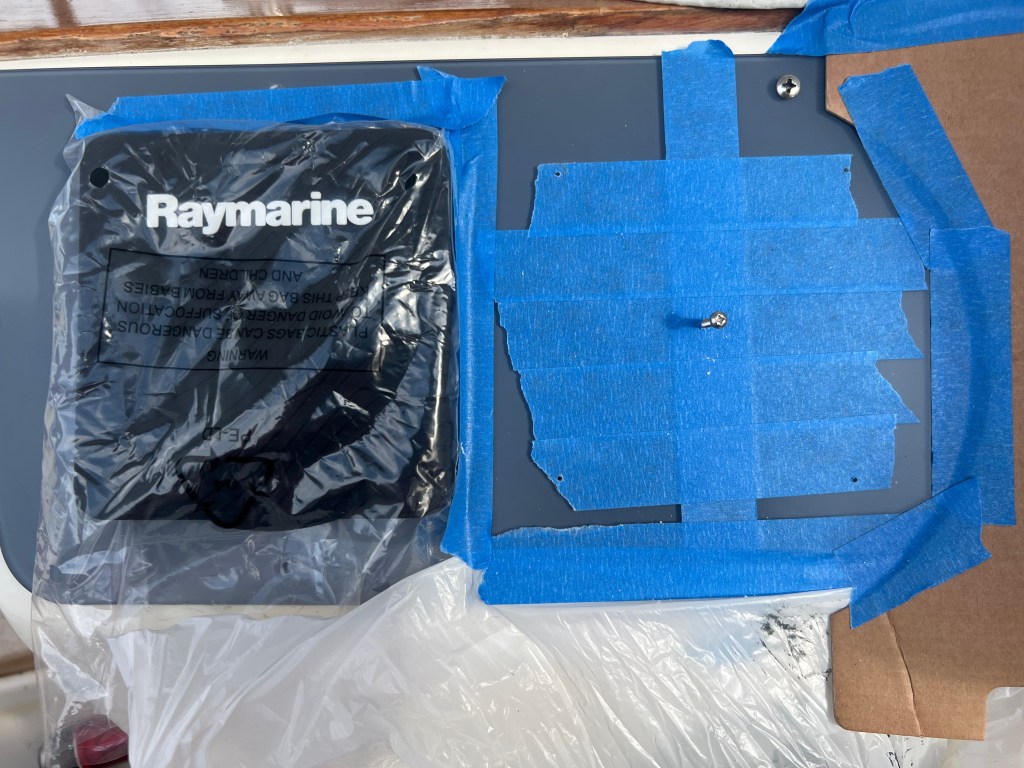
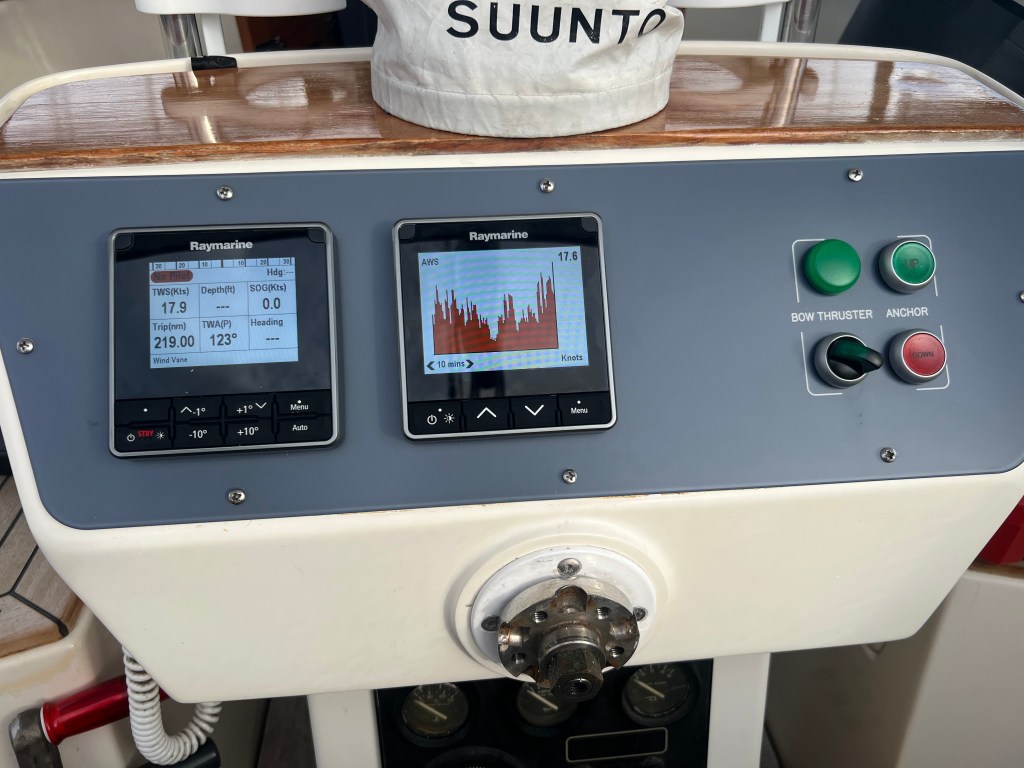
Finally, we installed a new Raymarine multi-function device at the helm. This was simple to do. I am excited to have the ability to trend data and analyze data to make better decisions while sailing.
Documentation
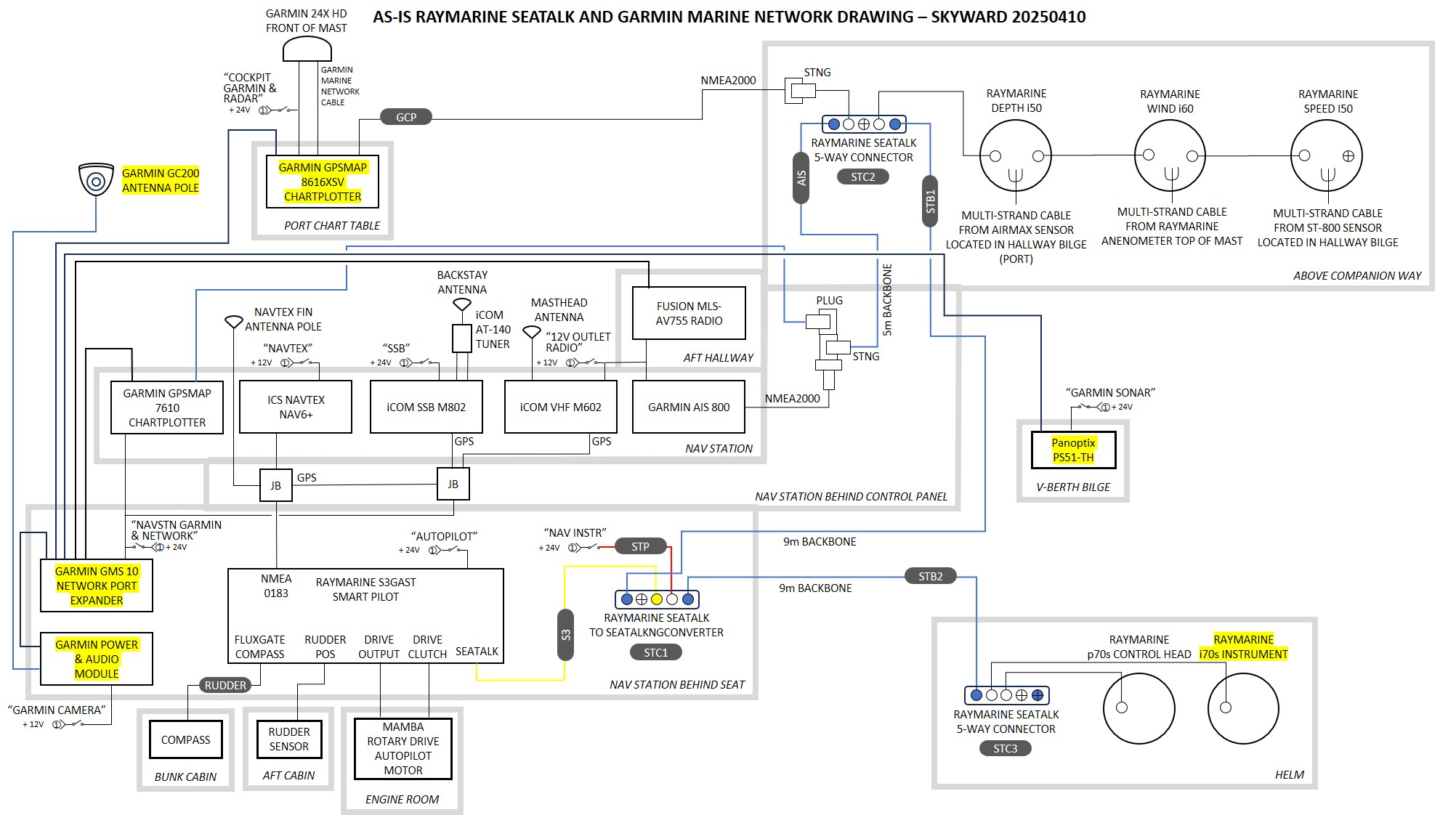
We documented the design in a network drawing which we update every time we make a change. The yellow highlights show what we changed, but they don’t truly indicate the enormity of the work we completed. The satisfaction of removing so much dead wiring is almost as good as having new gadgets to play with this season.
If you are familiar with the HR46 design and interior layout, most of them have a freezer behind the nav station seat backrest. Skyward does not have the freezer located in that location. The space behind the backrest is 100% open for storage, which is where I store tools.
We also eliminated the old satellite phone system from the boat during all of this work. It was amazing to see how much wiring was abandoned in place by previous owners and/or their contractors. This post covers most of the electrical instrumentation and networking upgrades that we did this Winter. Hopefully, it doesn’t go obsolete in the next 4-5 years!
 The Loxodograph