

It all began one afternoon when I casually stopped into the The Rigging Co. shop where Skyward’s rigging was being rebuilt.
After shooting the breeze with Aaron and Colin, I was looking around for our passive radar reflector. I had only ever seen it from the position of a bosun chair while climbing the mast; it was installed on the D2 on the starboard side. It was the tube style.
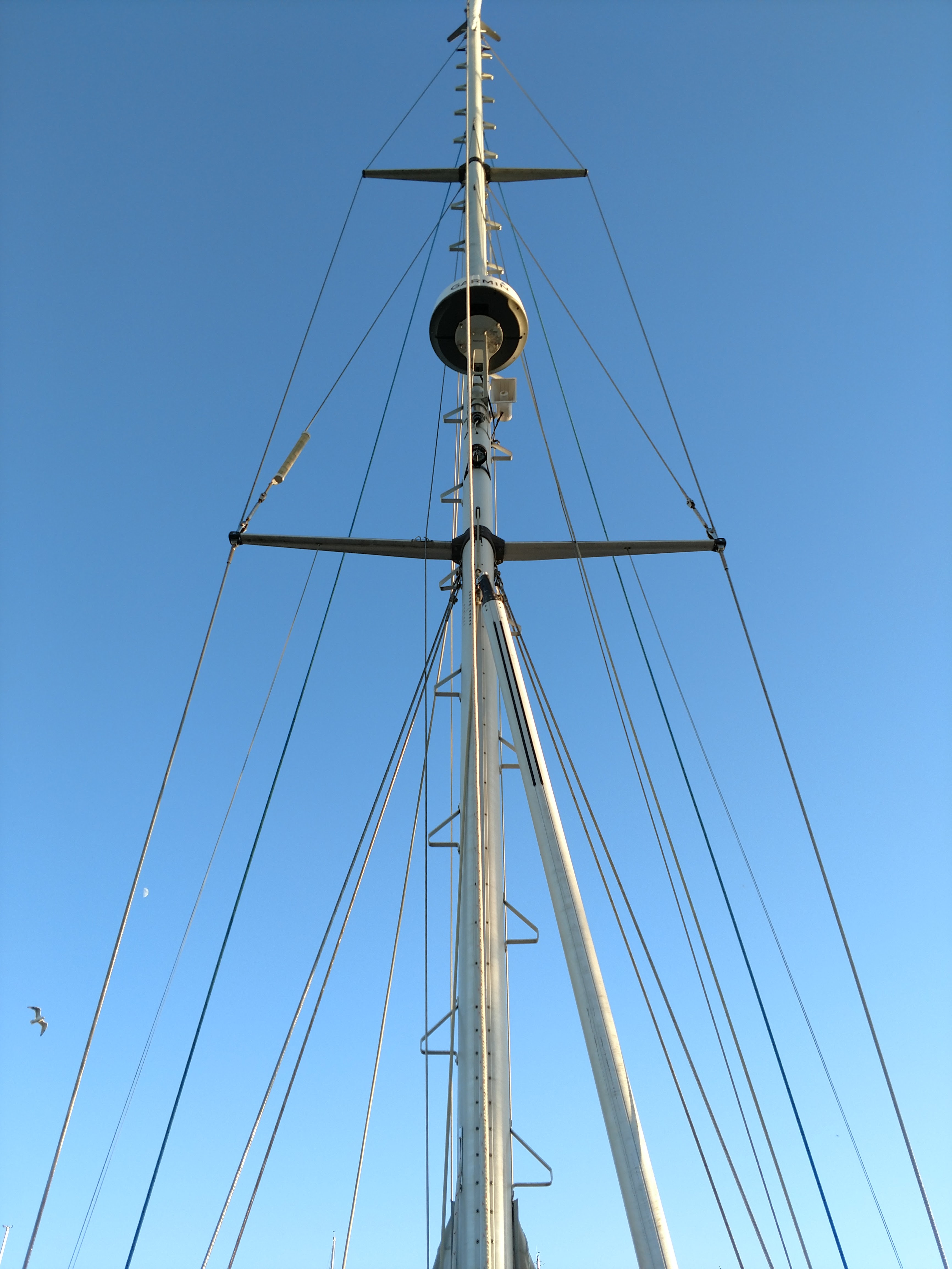
Searching high and low in the shop, I couldn’t find it. Afterwards, Aaron took me outside the shop where our boom was stored alongside other projects they are working on. We looked over at a 20+ year-old mast from someone else’s sailboat that The Rigging Co. had just completely tore down, prepped and painted. It looked brand new and the finish was spectacular, but what struck me was the large Tri-Lens passive radar reflector installed on the mast. We got to talking about passive vs. active radar and the pros and cons of each. Then I started to run some date calculations in my head, and then I realized that I have around 3 weeks until we step the mast (!). We need to get everything done to the mast that we can before we step it, especially anything electrical or being installed at or near the masthead.
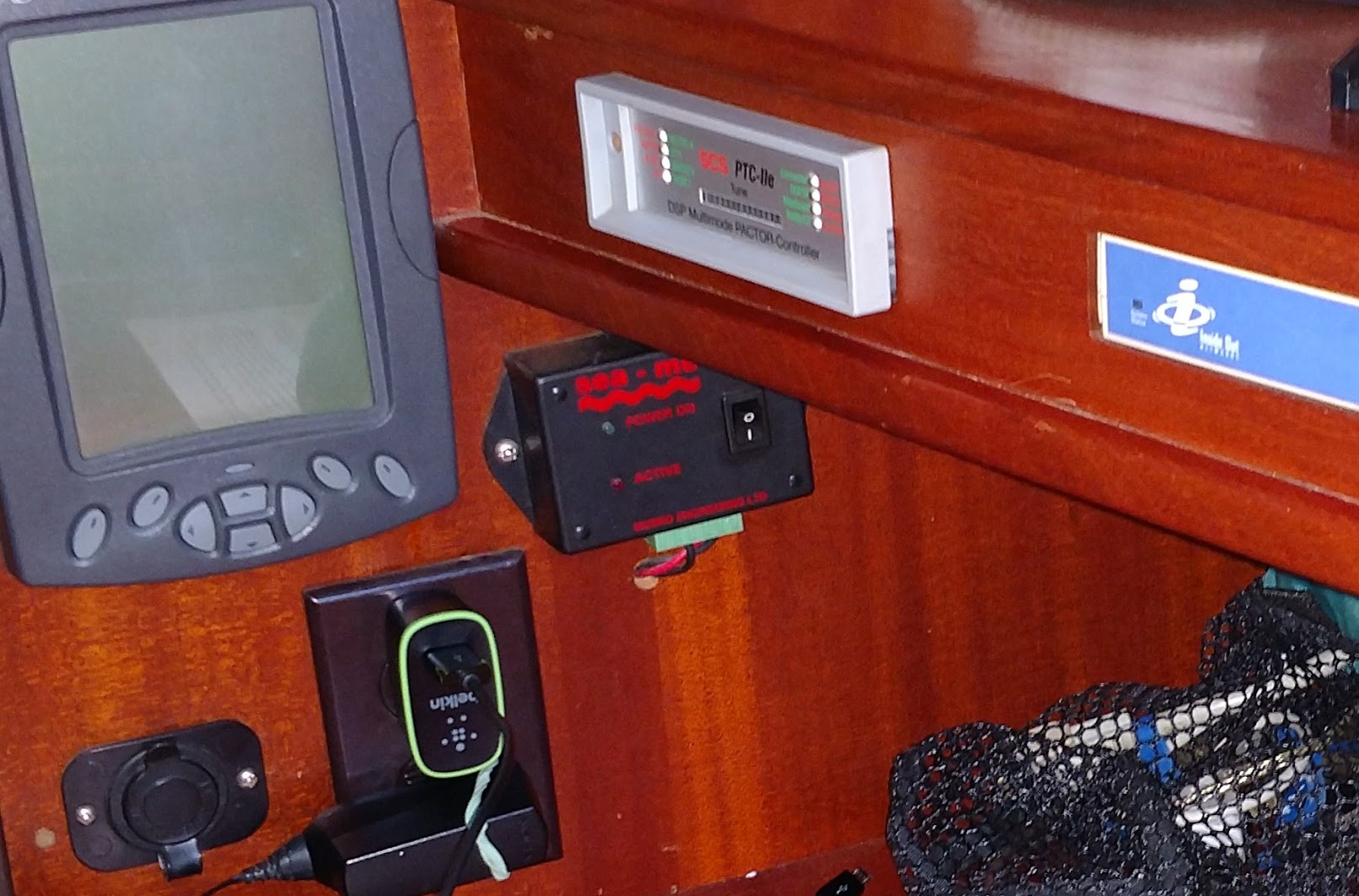
The Sea-Me active radar reflector on Skyward was reportedly hit by lightning on the Chesapeake some time prior to 2017. The Sea-Me radar antenna was nowhere to be found – I have never seen it installed on the mast nor anywhere in any one of the 1,000 storage locations on the boat. But the Sea-Me radar control box remained abandoned in place at the nav station with some nice holes in the mahogony that I will probably have to patch up.
With some time pressure, I need to make a quick but informed decision. to replace the Sea-Me active radar reflector and/or tube style passive reflector. Skyward has a Garmin 800 AIS, and as everyone says, this is the #1 tool to avoid c0llision and see other boats.
Sea-Me is a Radar Target Enhancer (RTE). A quick internet search led me to conclude that this product is no longer available on the market. The only RTE that I could find on the market was EchoMax Active X or XS which sell for $900 or $1350, respectively. If you search online for radar reflectors at West Marine, Fawcett or Defender, and you will not find any RTE available. You will find a small selection of tube style reflectors and some EchoMax passive cannisters which mount to the front of a mast.
This opened up a lot of questions for me:
- Is there a market for radar reflectors (regardless of passive vs. RTE)?
- It seems that there are a lot of radar reflectors used by different boats, but these manufacturers and design options have seemed to narrow in the current market. Why is that?
- If having an RTE is such a good idea, why a) are they so expensive, b) are they not available at “big box” stores and c) is there only one producer on the market?
- Why buy a passive radar or RTE if you have AIS already?
- Does passive radar or RTE really help you be seen more readily and in what circumstances?
I reached out to our global HR owners blog regarding this subject, and what was shared with me was exactly what I needed to make an informed decision. The HR owners blog is an amazing community with expert knowledge with sea experience about the boats. It is truly invaluable as an owner to have this type of access; this is just one of the many reasons we purchased an HR. The reference shared with me by a member named Dave Skolnick was the QinetiQ report from 2007.
This research was conducted as a result of a tragedy, and the conclusions (click the image to link to the full report) lead me to believe that tube style passive radar was not useful whatsoever. Powered or RTE style radar reflectors were significantly and not surprisingly outperforming passive radar reflectors. But 16 years after this report, I still cannot answer why there is only one RTE producer on the market. If you are interested click here to read another report from the 2006-2007 timeframe that describes how EchoMax began competing with Sea-Me. If RTE is so good, why doesn’t every boat have one — why aren’t they provided on all new boats from the manufacturers?
Another member, Richard Munton, reminded us all in the blog that passive radar is required by ARC. An excerpt from the 2023 safety requirements is shown below (click the paragraph in the image to be taken to the full set of requirements):

Amongst the many conversations I was having and the number of inputs coming to me, I came to the conclusion that AIS and radar/chartplotter combinations have become the top collision-prevention systems. But if you want to sail in the ARC, you are still required to have a passive radar. Therefore, RTEs seem to have been effectively squeezed (and priced) out of the marketplace. You can buy a Garmin 800 AIS for less than $900, where as an X+S band RTE will run you over $1300. And, while doing my research, the RTEs only give visual signal if another boat scanned your radar — no audible signal. To me, a visual signal is worthless if I am at the helm and the control box is located at the nav station.
Furthermore, The Maritime and Coastguard Agency (MCA) updated its guidance on the use of a radar reflector on boats less than 15m/49.2ft and under 150 gross tonnage in 2022. They stated that a radar reflector or radar target enhancer should be permanently installed on a recreational boat with an RCS of at least 7.5m² at X-Band and 0.5m² at S-band when mounted at a minimum height of four metres above sea level.
After 16 years since the report (which is widely referenced throughout the industry) why would Defender and West Marine still offer to sell tube style radar reflectors on their website? These companies are very well run, and I have no complaints whatsoever to purchase parts with these companies. Why would Plastimo still make them? I don’t understand why these companies offer to sell a piece of safety equipment that is sub-par.
As a result of the research conducted by QinetiQ, the only passive radar system that seemed to be worthwhile based on the data is a big cannister style reflector by EchoMax. I decided to purchase the EchoMax 305 because, according to Landfall Navigation, “The EM 305 model has been successfully tested by QinetiQ to ISO 8729, SHIPS WHEEL MARK, SOLAS a RORC and ORC and meets sections A.1/1.33 and A.1/4.39 of annex A1 of Marine Directive 98/95/EC”.
I hope you find this information useful. I will write another blog once we have this unit installed and I have an opportunity to ask a fellow mariner how we are showing up on their radar.
 The Loxodograph