

Imagine we are having one of those casual sailor-to-sailor conversations, and I ask ‘How do you get your weather data when coastal or offshore?’ I’m sure that in 2024 the response might be PredictWind, Windy, NOAA, or coastal buoys. Or possibly, we would turn the conversation to Starlink, Inmarsat or Inreach with regards to communications enabling you to get weather data. Some of you might say that you have a XM satellite radio/weather unit or maybe your boat is set up with SSB and can receive weather through WeatherFax or other approaches over those airwaves. There are a lot of options and approaches, but if you were to say that you have Navtex, then I have a story for you.
1st Step: Install Starlink
We bought a gen3 Starlink dish, and I wanted to get that installed as quickly as possible late this Summer to prepare for a long weekend trip. Starlink installation; it can’t be that hard, right?
While routing the RJ45 antenna cable, I had to expand wire chase hole sizes in the carpentry to ensure that the big honking Starlink cable connector could pass through all walls from the aft to the navigation station. Raise your hand if you know what I’m talking about.

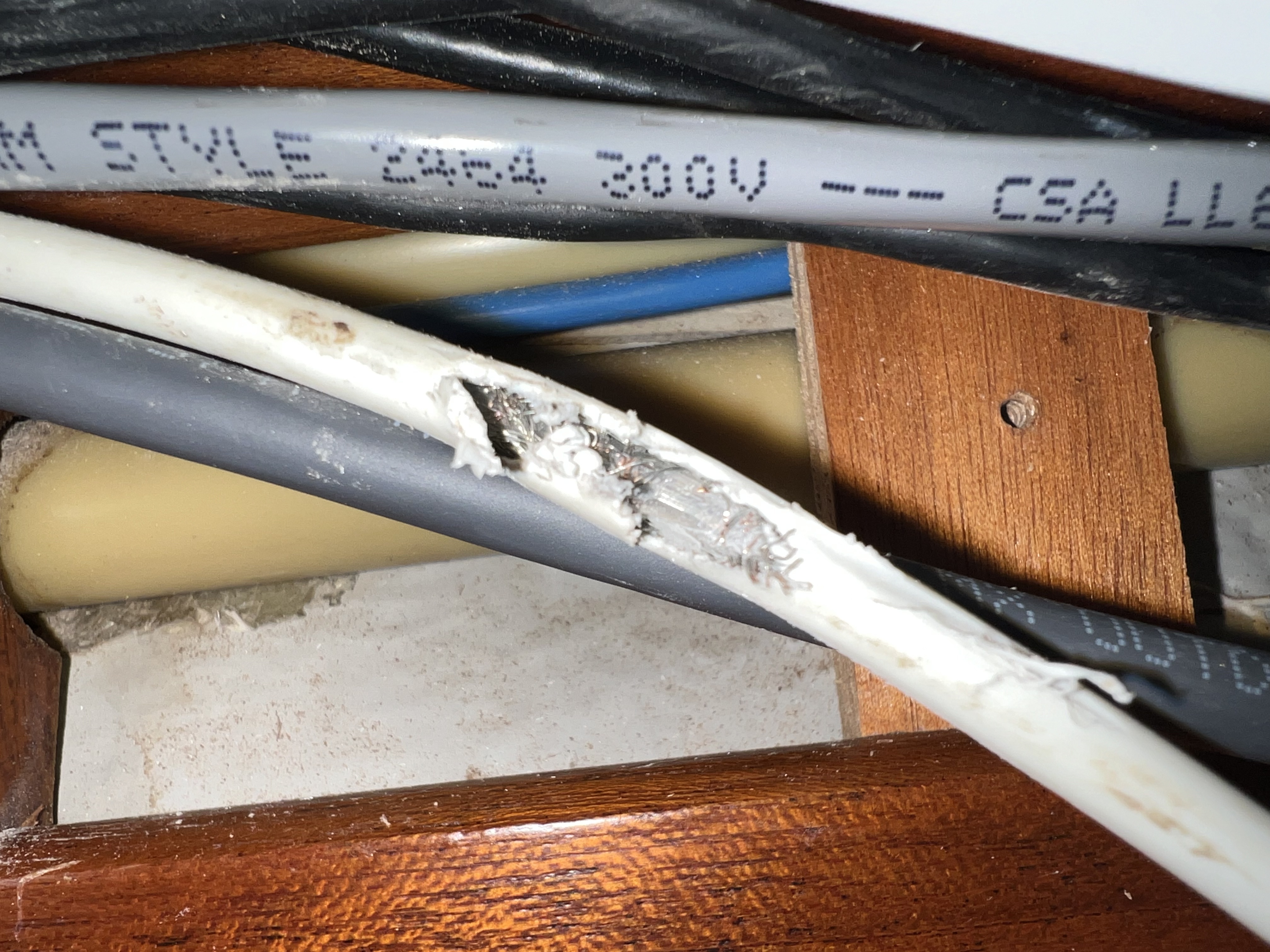
I had one of those moments where I just went full-bore project manager to ensure the task got done instead of taking my time to think everything through. I pulled out my largest diameter drill bit and tried to widen existing holes that had wire already passing through them. In a perfect world, I would have to drill horizontally alongside several other lines. No problem, and there is always a ton of space on a boat for a huge drill bit and portable drill to fit inside a cabinets, right? The result: Oh sure…I got the Starlink connector through the new holes, but I also accidentally cut through both my Navtex antenna cable and a backup GPS cable with the drill bit. That opened Pandora’s box.
What is Navtex?
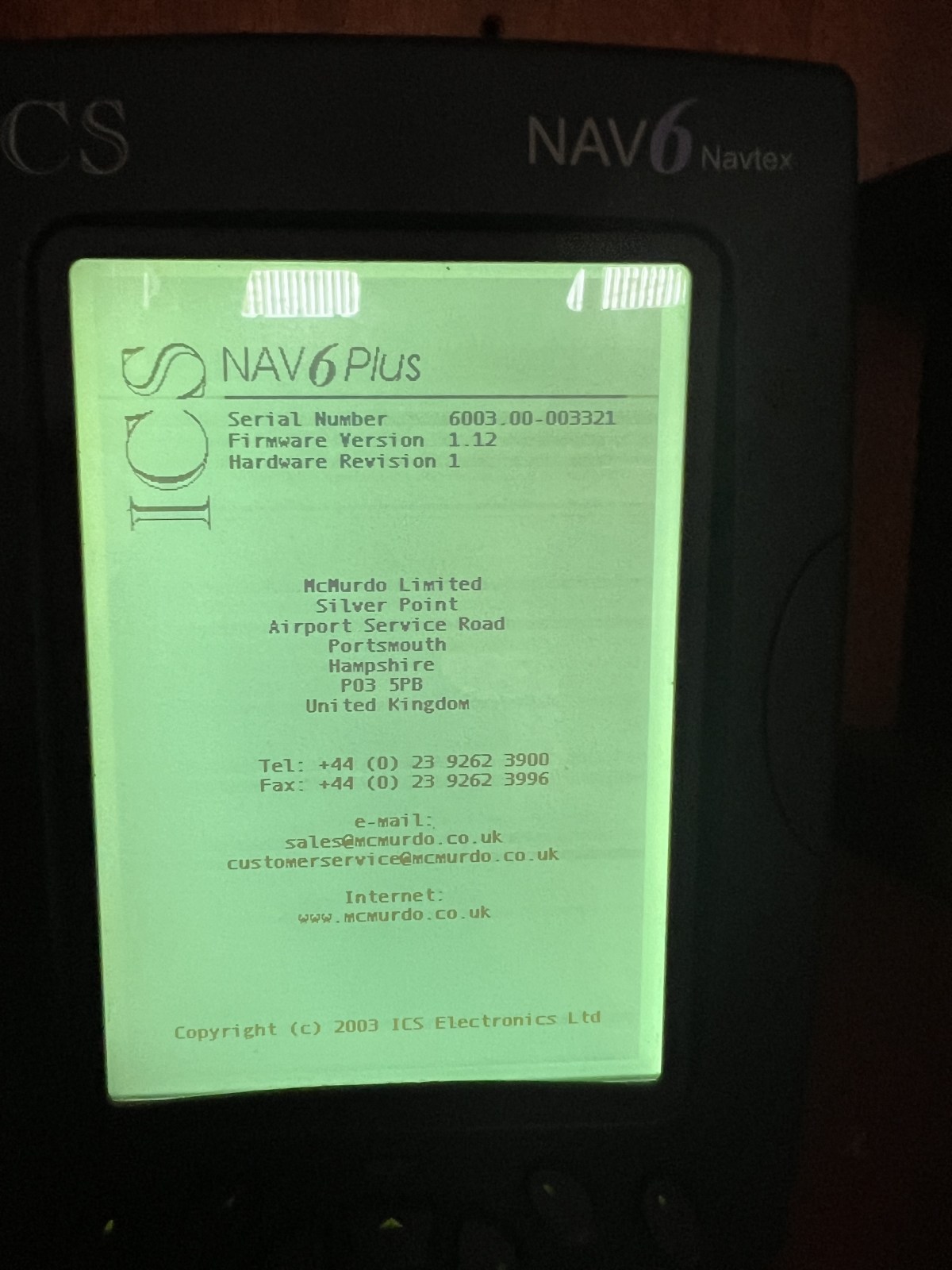
Let’s back up a bit. One of the things I really liked about Skyward when we purchased it was that it was “kitted out” for offshore sailing by previous owners. It had 12 winches, 7 sails, Solent rig, watermaker, solar, safety gear, electronics, and other components which gave me some peace of mind as a buyer that the boat was ready to go. The joke was on me in many instances. One of those offshore “kits” was the ICS Navtex 6plus and a fin-style antenna.
The International Maritime Organization has designated Navtex, an automated medium frequency direct-printing service, as the primary means for transmitting coastal urgent marine safety information to ships worldwide at sea within approximately 250 nautical miles off-shore.
Navtex information requires two systems to be in working order: 1) Broadcast towers situated all over the world in strategic locations and 2) Receiver systems aboard boats. In the United States, NAVTEX is broadcast from Coast Guard facilities in Cape Cod, Chesapeake VA, Savannah GA, Miami FL, New Orleans LA, San Juan PR, Cambria CA, Pt. Reyes CA, Astoria OR, Kodiak AK, Honolulu HI, and Guam. The towers broadcast weather content (messages) about 4 times daily at prescribed times on specific frequencies. In the US, the towers are supposed to be maintained by the Coast Guard.
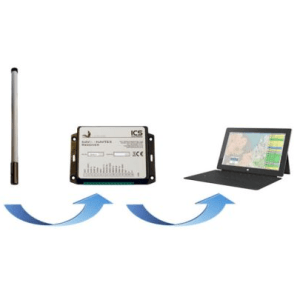
The broadcasts can be freely obtained by anyone with a receiver and decoding system. In our case, the fin-style antenna is both an antenna and receiver, which then decodes the messages and sends them to a visual screen mounted at our nav station.
2nd Step: Get Navtex Working
We have not taken advantage of this infrastructure aboard Skyward, yet, mostly because we have been focused elsewhere, and we haven’t spent much time off-shore. When we purchased the boat in 2021, I must have turned on Navtex unit because there were messages in the archive from that period of time. So I know that the on-board system worked fine at one point in time. But now I had to deal with a cut antenna/data line. The line is a 2x twisted pair with an insulated static wire on the outside. I chased down a source for an entirely new wire, and I pulled the new line and made a new junction box to connect the remaining cable to the new cable.
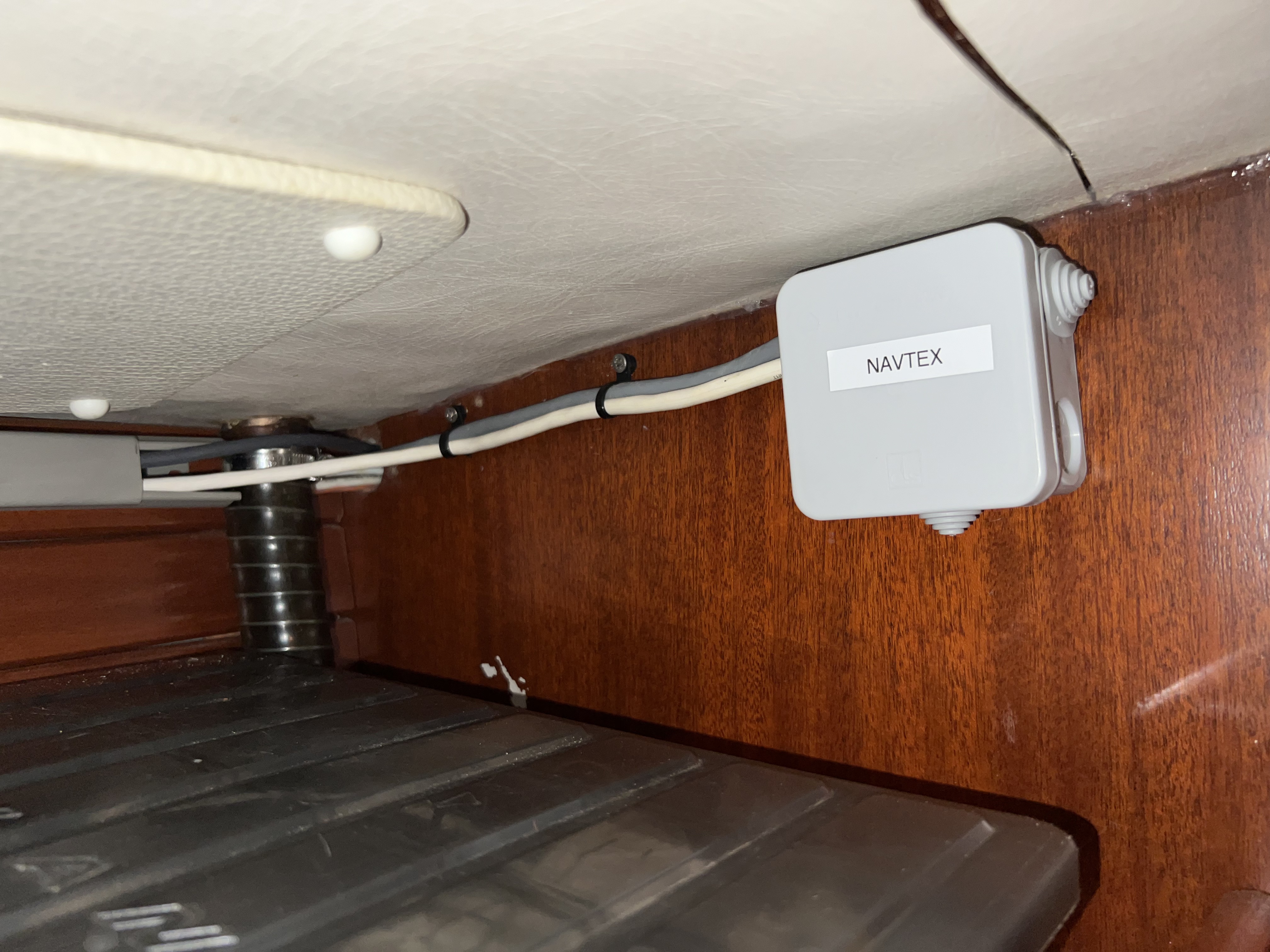
During this process, I got distracted and realized that the previous owners never connected the Navtex panel to the onboard NMEA (e.g., GPS) data. Now I believe I have a working antenna, receiver, and a panel as well as more data coming into the panel to make it more useful as a repeater at the nav station. Wouldn’t you know it? The NMEA data was coming in fine, and the system was indicating that the GPS signal was fine.

But there were no new Navtex messages coming in. Recall that towers only transmit 4 times daily, and apparently they are not exactly at the same time every day. Some days the afternoon messsage is transmitted at 4:33pm and other days it is 4:57pm, and so forth. So, I would spend hours with the system turned on waiting and guessing for when the next transmission would be. I would monitor the Navtex website for my area which is where all messages are also posted online. Again, the concept is that if I do not have the internet, Navtex can receive these messages over the airwaves. But, it appeared that my Navtex installation was not working.
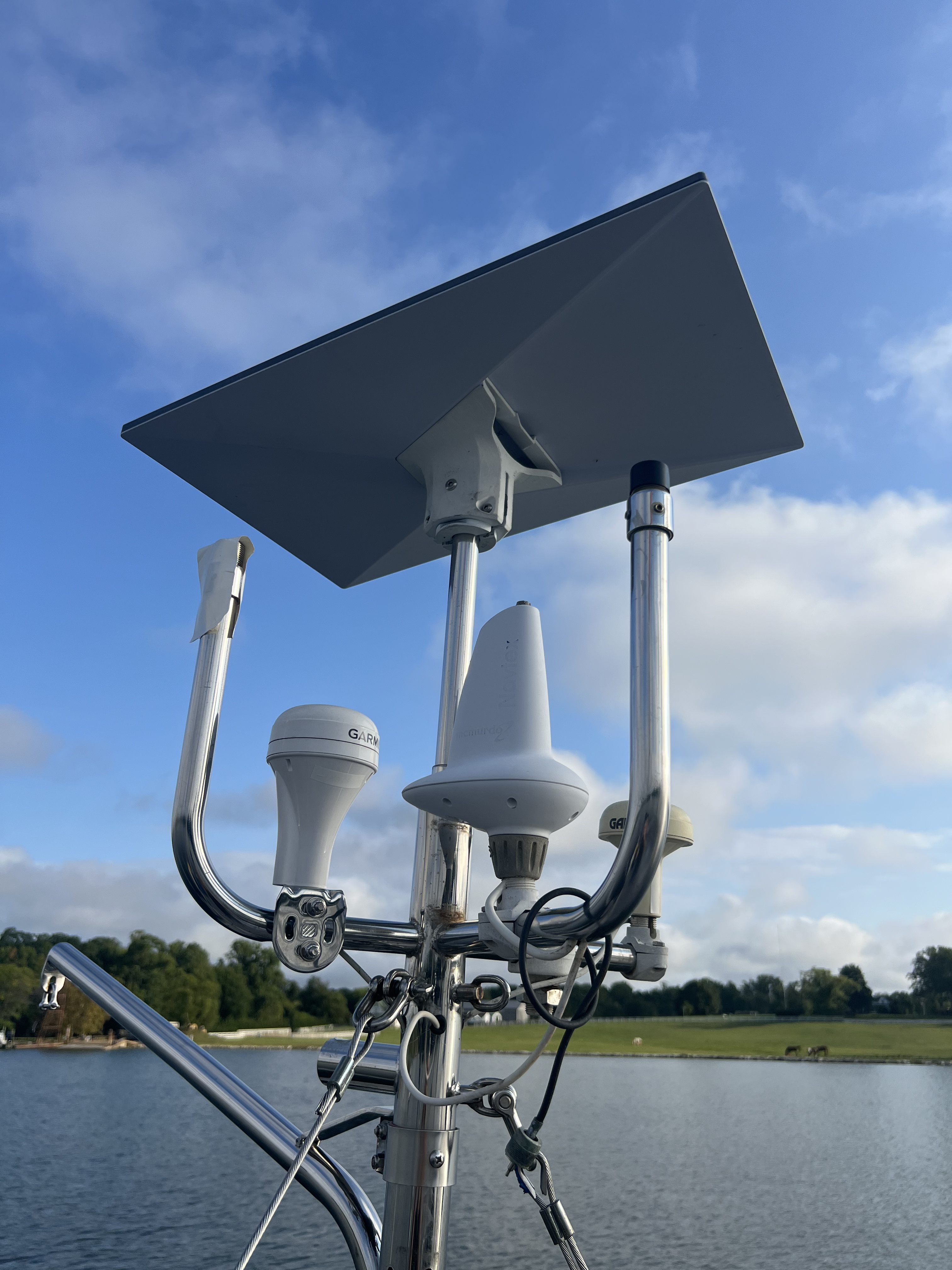
I investigated the antenna. The fin style antenna serves as an antenna and a receiver. Inside the antenna housing is a electronic circuit board that processes the data and transmits it to a visual display. The below pictures show the fin style antenna body and the bottom and top of the circuit board.

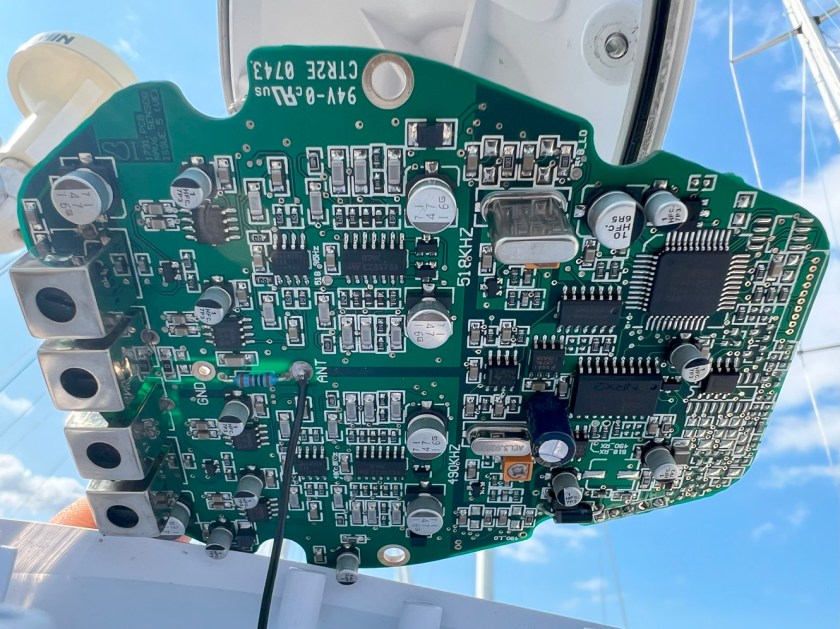
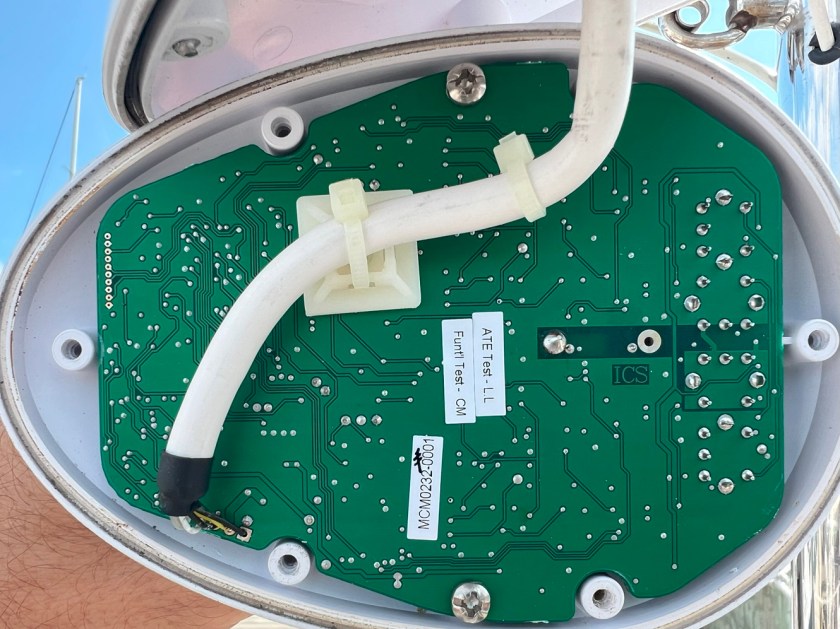
Nowadays, ICS only sells a powered antenna which receives the transmission, then sends it to a remotely mounted processor.
I suppose the concern is that the older antennas like mine were prone to leaking and causing corrosion and deterioration of the electronic circuit board. After opening up the very-well-sealed antenna housing, the board looked perfectly fine and brand new.
Then I checked over my antenna/data cable that I just fixed. I was properly sending power to the antenna and the connections were properly made.
Data was being published on the Navtex website every 4 hours, but I still had no data on my visual panel (6plus). I messed around with the setup and configuration parameters and reviewed all of these with ICS.
Step 3: Conclusion – It’s Not on My End
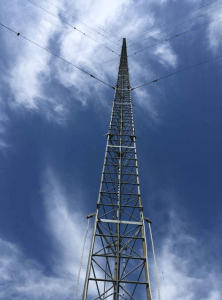
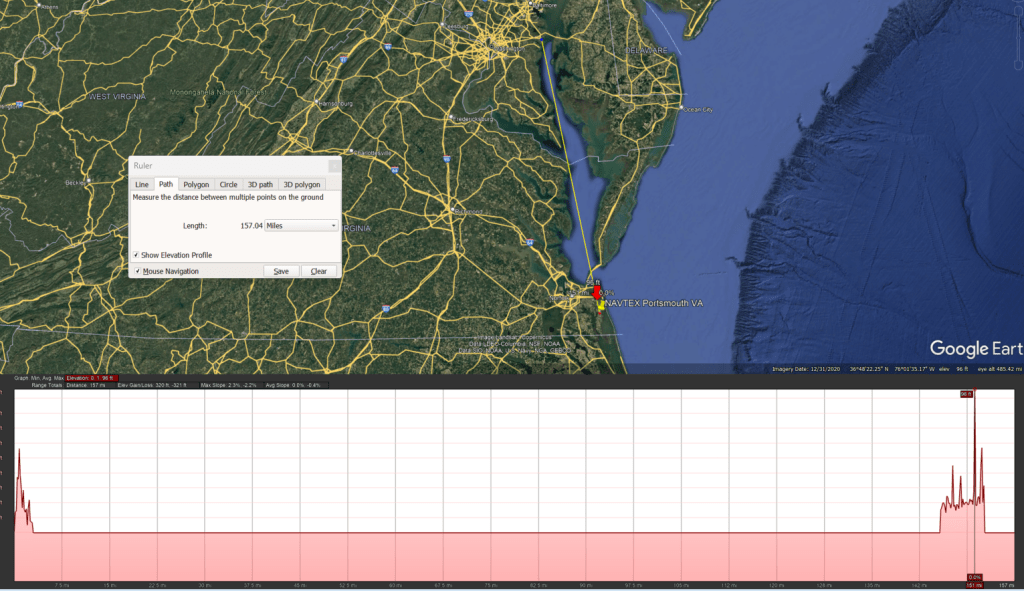
I was convinced that my system was set up and configured correctly and it was working fine. The only other root cause that I didn’t verify is whether or not I was actually able to receive Navtex transmissions in Annapolis from the nearest tower. If you look at the Navtex website, it says that there is a tower in Chesapeake, VA in the first paragraph of the website, but further down in the table, it states that the tower is in Portsmouth, VA. You have to dig and dig to determine that the Portsmouth, VA tower is 300 feet tall and supposedly located at 36° 42′ 57.395″ N 76° 00′ 28.800″ W and is broadcasting at 750 W of power. Making an elevation profile, there is very little in between Back Creek, MD and the Portsmouth tower other than some trees. The 300ft tower is plenty tall.
ICS suggested that I use my SSB system aboard Skyward to test the ability to recieve Navtex transmissions. My Navtex antenna is on our aft antenna pole and mounted about 10-12 feet above the water. My SSB antenna is near the top of my mast approximately 60 feet above the water, because the top isolator is just below the masthead. Even though I am only 157 miles away from the tower, when I tuned my SSB to 516.3 Hz for hours and hours, I heard nothing. The USCG Report No. CG-D-04-18 Navigational Telex (NAVTEX) Modeling, April 2017 states that this tower should be able to transmit at least 275-280 miles.
It was possible that my SSB system had some issues due to my lack of experience in using it. However, my ICOM M602 is able to receive clear broadcasts on multiple tuned frequencies. This is when I put down my pencil and decided to contact the Coast Guard. Here is the response that I received:
Good Morning,
NMN NAVTEX has been down for a few months and will continue to be down for a while. We have no estimated time of repair unfortunately.
v/r,
U.S. Coast Guard
Communications Command
In Summary
If you have a Navtex system aboard your vessel, there are several points to troubleshoot if it is not working. The Navtex 6plus can receive a lot of NMEA data, including waypoint names, and is a nice repeater for any nav station.
Most importantly, if you have Navtex and expect to use it for your Winter migration to the Bahamas or Carribean leaving from Hampton, VA, then do not count on having the information provided from the tower in Portsmouth, VA.
What I found most disappointing is that the Coast Guard has all of these assets and methods for communicating available, but their website doesn’t indicate the status of these systems. There is no way to determine the status of the Portsmouth, VA tower by searching online, and I had to contact the specific Coast Guard region to get this information. That makes me wonder whether or not any other towers in the US are active at this time. I was reassured by ICS that Navtex is quite popular in Europe.
In that light, if you are on a US-based boat, is it really a selling point to have Navtex aboard your boat ? Is it worth it to have (or to purchase new) if the transmission system can go down at any moment and the owners (Coast Guard) have no acountability to ensure it returns to operation quickly? I don’t think so at least for a US-based boat.
I’ll keep it aboard Skyward only because it is already installed, it technically is working, and it makes for a nice NMEA data repeater station. But now I am much more informed about the risks of relying upon it.
I have to thank Barrie at ICS for all of his relentless support and assistance through all of my investigations. He was remarkably quick in response and resourceful.
Bonus Tips
If you want to review Navtex messages for offshore on the high seas from Portsmouth, VA you can check out this link from the NOAA Ocean Prediction Center.
If you want to review National Weather Service forecasts for the Chesapeake Bay as you are traveling either down or up the Bay, check out this link.

 The Loxodograph
Jeff, i used to love Navtex in Europe, in addition to the weather you get all the navigation warnings which are a great asset. I feel the US thinks of it as old technology now which is a disservice to the mariner, not sure about the rest of the world.
LikeLike
use the app on the app store for msi egc
LikeLike
Curious, what is “msi egc”?
LikeLike
Maritime Safety Information Enhanced Group Call, search for navareas in the app store, the metareas are not included only the EGC messages as most people get their weather information from multiple sources. as messages are only available for 42 days a lot of messages can be missed especially when going into different navareas in Europe this is more so as you can traverse multiple areas in just 48 hours, so the app compliments the hardware that you would have on your boat. using the app and older hardware effectively gives you the functionality that you would find on systems like the Iridium LT3100s ability to see older messages and uptodate egc messages with no transmission delay
LikeLike
I just went through this same thing. I was building a NAVTEX system with a Raspberry Pi and software defined receiver and couldn’t receive anything from Portsmouth, VA, transmitting station. I finally decoded some skywave signal from Boston and New Orleans, so I know the system is working. I just wrote the CG this morning to find out the status of the station in Portsmouth and then found your blog! That they can keep this down for months yet list it as “active” everywhere is ridiculous. I agree, they need a real time status. As a minimum, it should be in the Notice to Mariners, but I looked there and couldn’t find any mention of it.
LikeLike